Print vs. Digital Reading Practice for Kids
A balanced, research-informed guide to help parents and teachers decide when print books, digital tools, or a thoughtful blend of both best supports a child's reading growth.
Explore Reading Resources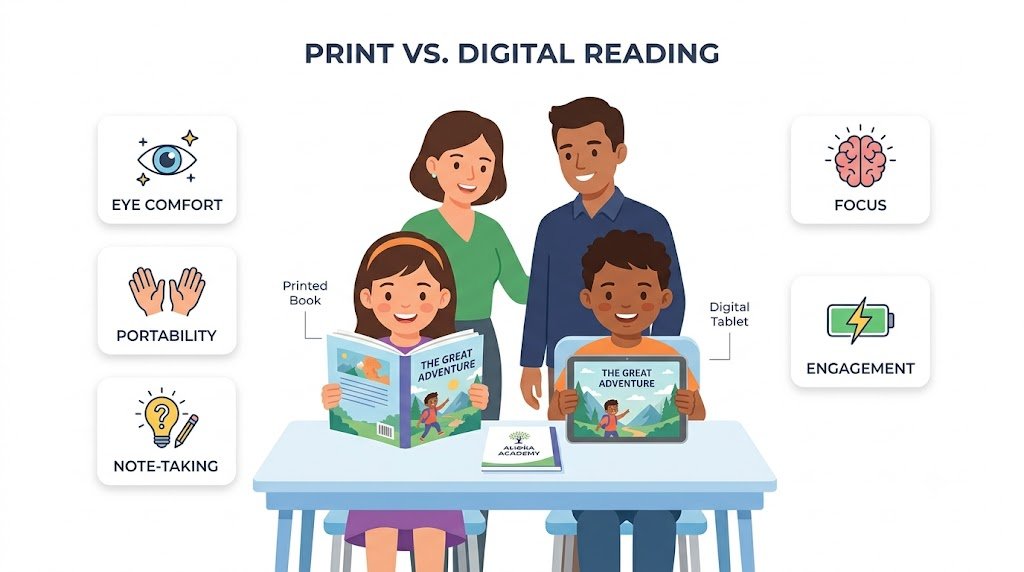
Both print and digital formats offer unique reading experiences — understanding their differences helps you make informed choices for young readers.
Every parent and teacher wants children to become strong, enthusiastic readers. But in a world filled with tablets, e-readers, and interactive reading apps, a common question keeps surfacing: is there a meaningful difference between print vs digital reading for kids? The short answer is yes — but the fuller picture is far more nuanced than simply declaring one format superior to the other.
Print books have been the backbone of literacy instruction for centuries, and a substantial body of research points to their unique advantages for comprehension, focus, and the development of deep reading habits. Digital reading, on the other hand, brings interactivity, accessibility features, instant word support, and an engaging multimedia experience that can captivate reluctant readers. Neither format is inherently good or bad — what matters is how, when, and why each is used.
This guide examines print vs digital reading for kids from multiple angles: cognitive development, comprehension, engagement, accessibility, and practical daily use. You'll walk away with a clear understanding of what each format does best, common pitfalls to avoid, and how to build a reading routine that draws on the strengths of both. For more foundational literacy guidance, visit our blog, where we cover everything from phonics to advanced comprehension.
Why Does the Print vs. Digital Debate Matter for Young Readers?
Reading is not a single act — it is a complex cognitive process that involves decoding symbols, constructing meaning, monitoring understanding, and integrating new information with existing knowledge. The medium through which a child reads can influence every one of those processes.
When a child reads a printed book, the experience is typically linear and self-paced. There are no notifications, no hyperlinks, and no tempting "Read More" buttons. The physicality of the book — its weight, the texture of the pages, the visual sense of progress as the stack of pages on the left grows thicker — provides sensory cues that support memory and navigation. Digital reading, by contrast, often involves scrolling, tapping, and skimming through content presented in smaller, fragmented chunks. These differences may seem subtle, but they add up.
Understanding the print vs digital reading for kids debate matters because children are still building their reading brains. The habits, strategies, and neural pathways they develop now will shape how they read for the rest of their lives. Making thoughtful choices about format during these formative years gives children the strongest possible foundation. If you're concerned about a child who is falling behind regardless of format, our guide on helping a child behind in reading provides targeted strategies.
What Are the Unique Benefits of Print Reading for Children?
Print books offer several advantages that are deeply tied to how the brain processes physical text. These benefits are especially pronounced for younger readers who are still developing foundational skills.
Deeper Comprehension and Retention
Multiple studies in reading research have found that children — and adults — tend to comprehend and retain information better when reading from paper. One likely explanation is that print reading encourages a slower, more deliberate pace. Without the temptation to scroll or click, the brain engages more fully with the text, building richer mental models of the content.
Print books also provide fixed spatial landmarks. A child remembers that a particular detail appeared near the bottom of a left-hand page or right after a specific illustration. These spatial cues act as memory anchors, making it easier to recall and connect ideas. Digital text, which reflows and scrolls continuously, removes those anchors.
Reduced Cognitive Load and Fewer Distractions
A printed page presents exactly one thing: the text. A digital device presents the text plus menus, battery indicators, notification badges, and the ever-present possibility of switching to another app. Every one of those extras competes for a child's limited attentional resources. Print reading, by contrast, supports sustained, focused attention — the kind needed for building reading fluency strategies and deeper comprehension.
Eye Comfort During Extended Reading
Screen fatigue is real, and children's eyes are particularly sensitive to prolonged exposure to backlit displays. Print books eliminate blue light exposure and the flicker associated with screens, making them more comfortable for extended reading sessions. For children who read slowly or need extra time to process text, this comfort can make a meaningful difference in how long they're willing to sustain reading practice.
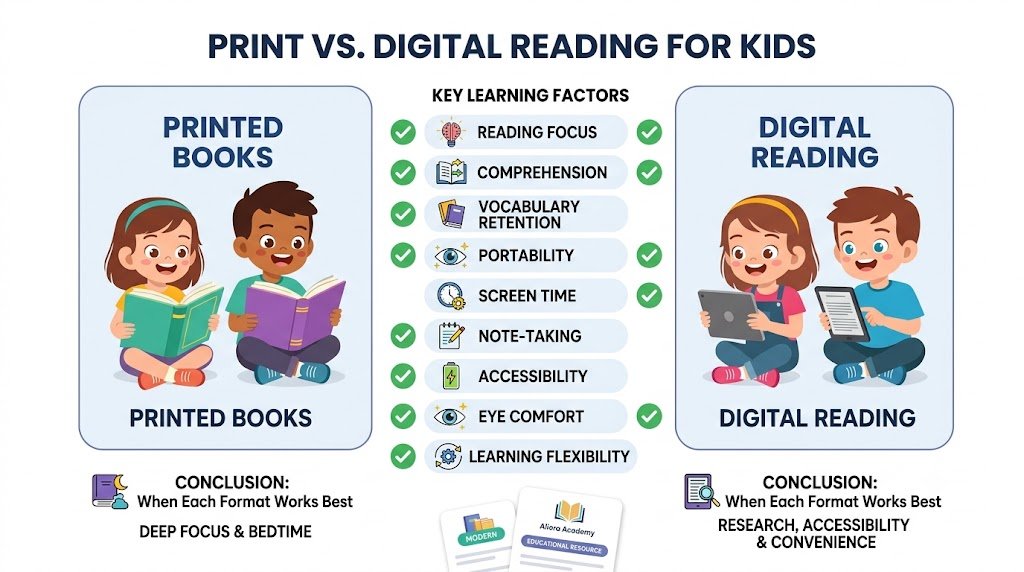
A distraction-free print reading environment helps children build the sustained attention essential for deep comprehension.
What Are the Unique Benefits of Digital Reading for Children?
Digital reading is not the enemy of literacy — far from it. When used intentionally, digital tools offer powerful features that print alone cannot replicate.
Built-In Reading Support Tools
Many digital reading platforms include features like text-to-speech, built-in dictionaries, and word highlighting that follows along with audio narration. For struggling readers, these tools can bridge the gap between frustration and understanding. A child who stumbles over a difficult word in print may simply stop reading; that same child on a tablet can tap the word to hear it pronounced or see its definition instantly. This just-in-time support keeps the reading flow intact and reduces discouragement.
Personalization and Adaptive Content
Digital platforms can adjust reading levels, font sizes, background colors, and line spacing to match individual preferences and needs. Children with visual processing challenges, dyslexia, or attention differences often benefit from these customization options in ways that standard print books cannot accommodate. For guidance on recognizing when a child may need additional support, see our article on signs of a reading disability.
Engagement Through Interactivity
Well-designed reading apps use interactivity thoughtfully — animations that reinforce the story, comprehension checks disguised as games, and rewards that celebrate progress. These features can be especially motivating for reluctant readers who have not yet discovered the intrinsic joy of getting lost in a book. Our guide on reading motivation for kids explores more ways to spark enthusiasm for reading.
Access to a Vast Library Anywhere
A single device can hold hundreds of books, making it possible for children to carry an entire library in their backpack. For families who travel frequently, live in areas with limited access to physical bookstores, or have children who devour books faster than a library run allows, digital reading provides unparalleled access to quality content.
Print vs. Digital Reading for Kids: A Side-by-Side Comparison
The table below summarizes the key differences between print and digital reading formats across the factors that matter most for young learners. Use this as a quick reference when making decisions about reading materials.
| Factor | Print Reading | Digital Reading |
|---|---|---|
| Deep Comprehension | Strong — fixed spatial cues support memory and mental mapping of content | Moderate — scrolling and reflowable text can weaken spatial memory and encourage skimming |
| Sustained Focus | Excellent — no notifications, links, or app-switching temptations | Variable — device distractions compete for attentional resources |
| Built-In Reading Support | Limited — requires adult or external dictionary for unfamiliar words | Extensive — text-to-speech, instant definitions, word highlighting, audio narration |
| Customization for Learning Needs | Minimal — fixed font, size, and layout for each book | High — adjustable fonts, spacing, colors, and reading levels |
| Eye Comfort for Long Sessions | Excellent — no blue light or screen flicker; comfortable for extended reading | Lower — backlit screens can cause eye strain; e-ink devices are a notable exception |
| Engagement for Reluctant Readers | Dependent on book selection and adult involvement | Often high — gamification, animations, and interactive features can spark initial interest |
| Portability and Access | Limited by physical weight and availability; one book at a time | Extensive — hundreds of titles on a single device; instant downloads anywhere with internet |
| Cost Over Time | Per-book cost; library borrowing reduces expense significantly | Device cost upfront; many free or subscription-based reading platforms available |
| Hands-On Annotation | Natural — underlining, margin notes, and sticky notes are tactile and memorable | Possible but less intuitive — digital highlighting and note-taking lack the same sensory imprint |
Neither column is universally "better." The right choice depends on your specific goal for a given reading session. A child practicing fluency with a decodable text may benefit most from print, while the same child exploring new vocabulary through an interactive app can gain skills that transfer back to print reading. Our reading resources collection includes materials in both formats so you can build a balanced toolkit.
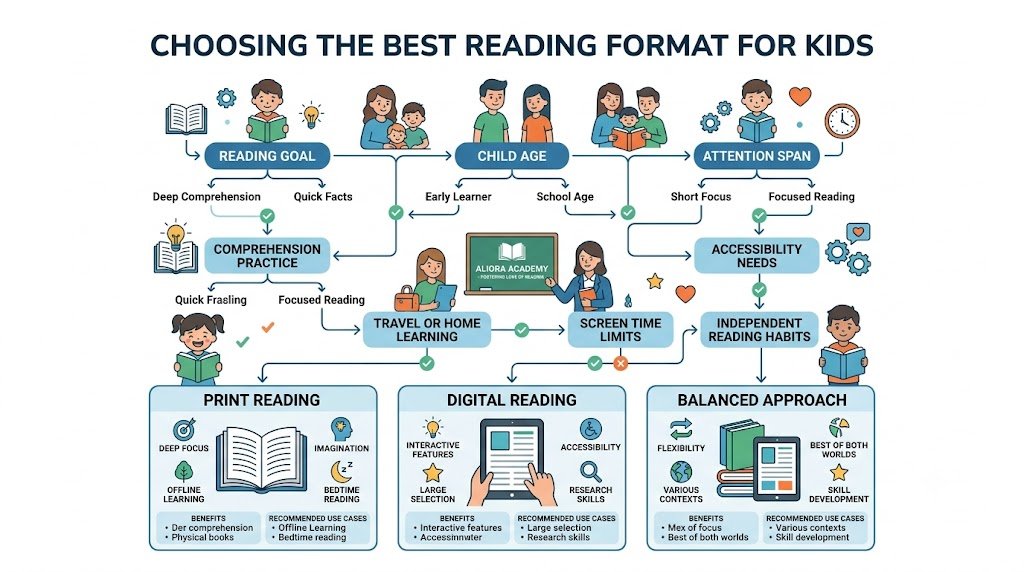
A blended approach — thoughtfully combining print and digital — often provides the richest reading experience for children.
How Do You Choose the Right Format for Different Reading Goals?
The most practical way to navigate the print vs digital reading for kids decision is to match the format to the purpose. Different reading activities call for different tools.
When Print Is Usually the Better Choice
- Building stamina for extended reading — chapter books, novels, and long nonfiction passages that require sustained focus.
- Practicing reading fluency — repeated reading of passages where tracking words with a finger supports accuracy.
- Bedtime reading routines — screen-free wind-down time supports healthy sleep habits.
- Deep study and note-taking — when children need to annotate, highlight, and flip back to review earlier sections.
- Shared reading with a parent or teacher — the physical book between two people creates a shared focal point that strengthens connection.
When Digital Can Be a Valuable Addition
- Supporting struggling or reluctant readers — audio narration, word lookup, and gamified practice can reduce frustration.
- Building background knowledge quickly — short articles, videos paired with text, and interactive nonfiction content.
- On-the-go reading — travel, waiting rooms, and situations where carrying multiple books is impractical.
- Practicing specific skills — phonics apps, vocabulary games, and comprehension quizzes with instant feedback.
- Accessing books when physical libraries are unavailable — remote areas, late hours, or when a child finishes a series and needs the next book immediately.
For children working on comprehension skills specifically, print workbooks and passages often yield better results because they encourage slower, more careful reading. Our guide on the best reading comprehension workbooks for elementary students features print resources designed for exactly this purpose. For homeschool families building a complete literacy curriculum, our homeschool reading workbooks page offers structured, print-based options.
What Does the Research Say About Print vs. Digital Reading for Kids?
While this article does not cite specific studies, the broader consensus from decades of reading research points to several well-established patterns. These are not controversial claims — they reflect consistent findings across the field of literacy education.
First, print reading tends to support better comprehension of longer, more complex texts — particularly narrative material where readers need to track characters, plot developments, and thematic threads across many pages. The physical act of turning pages and the fixed spatial layout of print both contribute to this advantage.
Second, digital reading often encourages faster, more superficial processing. Readers on screens tend to skim more and pause less frequently to reflect. This is not a flaw in the child — it is a learned response to the medium, shaped by years of interacting with digital content designed for quick consumption. Teaching children to adjust their reading approach based on the medium is an important part of reading strategies for elementary learners.
Third, the presence of an engaged adult — whether reading a print book together or discussing a digital story afterward — consistently outweighs the format itself in predicting positive reading outcomes. The medium matters, but the relationship and the conversation around the text matter more.
Common Mistakes Parents Make in the Print vs. Digital Decision
Even well-intentioned decisions can backfire when it comes to choosing reading formats. Here are the most common missteps — and how to avoid them.
Practical Examples: Print vs. Digital Reading in Real Life
Example 1: The Phonics Practice Dilemma
Situation: Ethan, age 6, is learning short vowel sounds in kindergarten. His parents have a phonics workbook and a highly rated phonics app, and they're unsure which to prioritize.
Challenge: Ethan rushes through the app tapping answers to see the animations but doesn't retain the letter-sound connections. The workbook, meanwhile, feels like a chore to him.
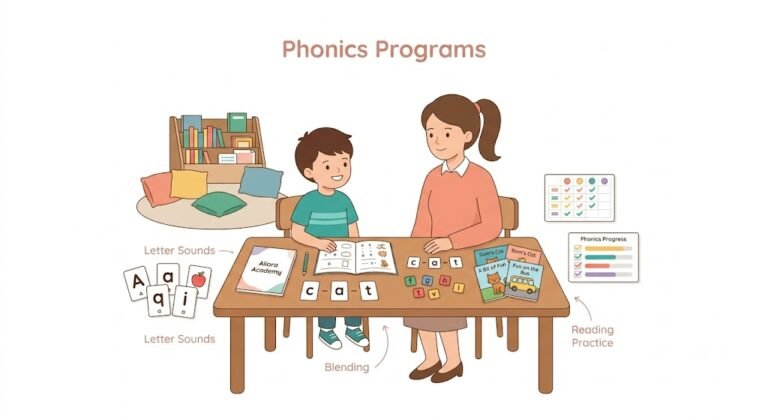
Solution: His parents restructured the routine. They used the app for short, timed sessions — five minutes of focused practice with a specific vowel sound — and followed up with the workbook page that reinforced the same pattern through writing. The app provided engagement; the workbook provided the deeper processing that comes from physically forming letters.
Learning Outcome: Ethan's retention of vowel sounds improved noticeably. The app motivated him to start; the workbook cemented the learning.
Takeaway: Digital and print can work sequentially rather than competitively. Let the digital tool introduce and engage; let the print material deepen and consolidate.
Example 2: The Reluctant Fourth Grader
Situation: Amara, age 9, avoids reading whenever possible. Her teacher reports that she reads below grade level and resists picking up any book. She does, however, love watching animal documentaries on a tablet.
Challenge: Amara has built a negative identity around reading. Print books represent failure and frustration to her.
Solution: Her parents started with high-interest digital nonfiction articles about animals — the same topics she loved in documentaries — at a reading level she could manage comfortably. The built-in read-aloud feature let her follow along without the pressure of decoding every word. Gradually, they introduced short print nonfiction books on the same topics, which she was now eager to read because she already had background knowledge.
Learning Outcome: Within months, Amara's reading volume increased dramatically. The digital bridge gave her access to content that matched her interests while her skills caught up.
Takeaway: For reluctant readers, digital content can serve as a low-pressure entry point that rebuilds confidence and curiosity before transitioning back to print.
Example 3: The Homeschool Balancing Act
Situation: The Martinez family homeschools their three children, ages 7, 9, and 11. They have a limited budget and a small home library but reliable internet access and one shared family tablet.
Challenge: They need to provide quality reading practice for three different skill levels without buying hundreds of books or relying entirely on screen time.
Solution: The family built a hybrid system. They invested in high-quality print workbooks for skill-specific practice — handwriting, phonics reinforcement, and comprehension exercises — and used the tablet primarily for access to library e-books, audiobooks during long car rides, and a vocabulary app the children used for ten minutes each day. Their weekly library visit became a cherished ritual for choosing print books purely for pleasure reading.
Learning Outcome: All three children made steady progress. The youngest benefited from the tactile nature of print phonics work; the oldest enjoyed the independence of choosing and downloading his own e-books. The family spent less than they would have on either all-print or all-digital alone.
Takeaway: A thoughtfully designed hybrid approach can be both effective and budget-friendly. Use print for skill building and deep reading; use digital for access, convenience, and engagement.
How Can You Build a Balanced Print and Digital Reading Routine?
The most successful reading routines treat print and digital as complementary tools rather than competing options. Here is a practical framework you can adapt for your home or classroom.
Start by identifying your non-negotiables. For many families, bedtime reading is sacred print-only time — no screens, no notifications, just a physical book and a lap to sit in. Protect that ritual. Similarly, consider designating a specific time of day for focused skill practice using print workbooks, which encourage the kind of careful, deliberate work that builds foundational skills like teaching main idea and details.
Then, layer in digital reading where it adds genuine value. A phonics app during the morning learning block, an e-book on a long car ride, or a digital reading platform that lets your child explore new genres without financial commitment are all reasonable uses of screen-based reading time. The key is intentionality — every time a child picks up a device for reading, there should be a clear purpose behind that choice.
For comprehensive literacy support, explore our homepage where you'll find curated resources spanning both print and digital formats. If you need personalized guidance on building a balanced reading plan, feel free to contact us — we're here to help.
Frequently Asked Questions About Print vs. Digital Reading for Kids
At what age should children start using digital reading tools?
There is no single right age, but many literacy specialists recommend prioritizing print for children under six, when foundational skills like tracking words from left to right and associating letters with sounds are still developing. Short, supervised sessions with high-quality reading apps can be introduced gradually as children enter elementary school. The key is adult involvement — young children benefit most from digital reading when a parent or teacher is alongside them, discussing the content just as they would with a print book.
Does reading on a screen negatively affect a child's eyes?
Extended exposure to backlit screens can cause eye strain, dryness, and discomfort — a condition sometimes called digital eye strain. Children who read for long periods on tablets or phones may blink less frequently and experience fatigue. E-ink readers, which use reflective light similar to paper, significantly reduce this concern. For backlit devices, encourage frequent breaks, maintain appropriate brightness levels, and avoid screen reading right before bedtime, as blue light exposure can interfere with sleep.
Can digital reading help a child with dyslexia?
Yes, in many cases. Digital platforms that offer customizable fonts, adjustable line spacing, text-to-speech with synchronized word highlighting, and built-in dictionaries can remove barriers that print books present for children with dyslexia. These tools do not replace structured literacy instruction, but they can make independent reading more accessible and less frustrating, which in turn increases reading volume and builds confidence.
Is it okay for my child to read exclusively on a tablet?
While a child can certainly develop reading skills through digital reading, an exclusively digital reading diet may miss out on the unique benefits print provides — particularly for deep comprehension, sustained attention, and the development of a calm, focused reading habit. Strive for balance rather than exclusivity. Even a few print books in regular rotation alongside digital reading can provide the cognitive variety that supports well-rounded literacy development.
How do I know if a reading app is high quality or just entertainment?
Look for apps that prioritize the reading itself over flashy animations and reward systems. Quality reading apps keep the text central, offer features that genuinely support comprehension (like word highlighting during read-alouds or thoughtful comprehension questions), and avoid excessive gamification that distracts from the story. Read reviews from teachers and literacy specialists, and spend a few minutes exploring the app yourself before handing it to your child. If the reading feels secondary to the game elements, the app is probably better categorized as entertainment than educational reading practice.
Should schools use more print or digital reading materials?
Most literacy experts recommend a balanced approach in classrooms. Print materials are often preferred for direct reading instruction, fluency practice, and extended independent reading. Digital tools can enhance differentiation — allowing teachers to assign texts at varied reading levels, provide instant feedback on comprehension checks, and give struggling readers access to audio support without stigma. The ideal classroom integrates both strategically, choosing the format based on the specific learning objective rather than defaulting to one or the other.
What about audiobooks — do they count as reading?
Audiobooks do not replace the need to develop decoding and print-based reading skills, but they are an invaluable complement to a child's reading life. Listening to audiobooks builds vocabulary, exposes children to more complex sentence structures and ideas than they could decode independently, and develops listening comprehension — a skill that directly supports reading comprehension. For struggling readers, audiobooks paired with print text (immersion reading) can accelerate progress by allowing the child to access content at their intellectual level while their decoding skills catch up.
Moving Forward: Making Thoughtful Choices for Every Reader
The print vs digital reading for kids conversation does not need to end with a winner. The goal is not to declare one format superior but to understand what each format offers so you can match the right tool to the right moment. Print books build deep reading habits, support comprehension of complex narratives, and create screen-free sanctuaries where children learn to love the quiet immersion of a good story. Digital tools open doors for struggling readers, provide instant access to vast libraries, and engage children who might otherwise never pick up a book.
The children who benefit most from today's reading landscape are those whose parents and teachers make these choices thoughtfully — not based on trends or convenience alone, but on a clear understanding of each child's unique needs, strengths, and challenges. A balanced reading life is not about rigid rules; it's about flexible, informed decision-making that evolves as the child grows.
As you build your child's reading routine, remember that you are the most important factor in their reading success — more than any format, any app, or any workbook. Your engagement, your encouragement, and your willingness to sit beside them with a book — whether it's printed on paper or glowing on a screen — is what ultimately nurtures a lifelong reader. For continued support on your child's literacy journey, browse our reading resources, explore our blog for more in-depth guides, and contact us anytime you need help finding the right materials.