How to Teach Main Idea and Supporting Details
A complete guide for parents and teachers to help children identify the big picture in any text — and the evidence that backs it up.
Browse Reading Resources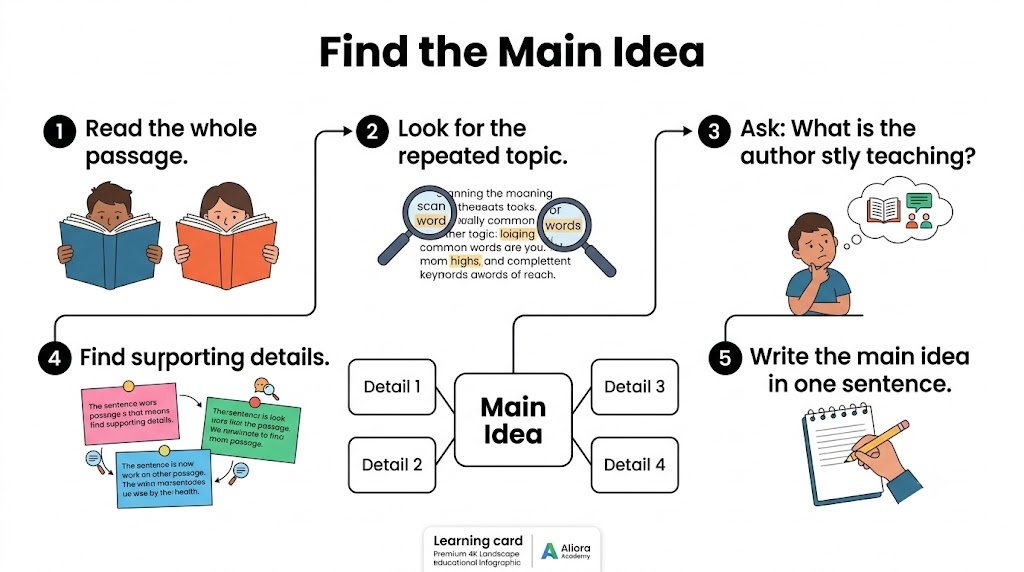
Using visual tools like graphic organizers helps children see how supporting details connect to the main idea.
You hand a child a short paragraph and ask, "What was that mostly about?" They stare at you blankly. Or worse, they latch onto a tiny, unrelated detail — the color of a character's shirt — and insist that's the point of the entire passage. If this scenario feels familiar, take a deep breath. You are not facing a comprehension crisis. You are facing a skill gap that is both common and highly teachable.
The ability to identify the main idea and recognize the supporting details that reinforce it is one of the most critical reading comprehension skills a child can develop. Without it, every text becomes a jumble of disconnected facts. With it, children begin to think critically, summarize effectively, and engage deeply with what they read. When you set out to teach main idea and supporting details explicitly and patiently, you give children a framework they will use for the rest of their academic lives.
This guide walks you through why this skill matters, how to introduce it at different ages, which strategies work best, and what resources can support your efforts — all grounded in well-established educational practice. For more background on reading comprehension, explore our blog, where we cover foundational literacy topics in depth.
Why Is Understanding Main Idea and Supporting Details So Important?
Reading without grasping the main idea is like assembling a puzzle without looking at the picture on the box. You might connect a few pieces, but you will never see the whole image. The main idea gives children a mental anchor — a central thought around which all other information organizes itself.
This skill impacts nearly every area of learning:
- Summarizing — A child who cannot find the main idea cannot summarize. They will either repeat the entire passage or grab a random fact.
- Note-taking — Effective notes capture big ideas and key evidence. Without this distinction, notes become useless word-for-word transcriptions.
- Writing — Strong writers build paragraphs around a clear central point. Understanding this reading skill directly improves writing structure.
- Test performance — Standardized tests consistently ask students to identify the main idea, choose the best summary, or recognize which detail supports a given point.
- Critical thinking — Distinguishing between what is central and what is peripheral is a thinking skill that extends far beyond reading class.
What Are the Signs a Child Struggles with Identifying the Main Idea?
Children rarely announce, "I'm having trouble distinguishing central ideas from supporting evidence." Instead, their difficulties show up in subtle ways that parents and teachers can learn to recognize.
Watch for these indicators:
- The child retells a story by listing every single event in sequence, with no sense of what mattered most.
- When asked "What was the main idea?", the child consistently picks a minor detail — often the most vivid or interesting one rather than the most important one.
- The child can answer factual recall questions but struggles with "why" or "what was the author's point" questions.
- Summaries are either one sentence too vague to be meaningful or several paragraphs that simply restate the original text.
- The child avoids open-ended reading response tasks and prefers worksheets with clear right-or-wrong answers.
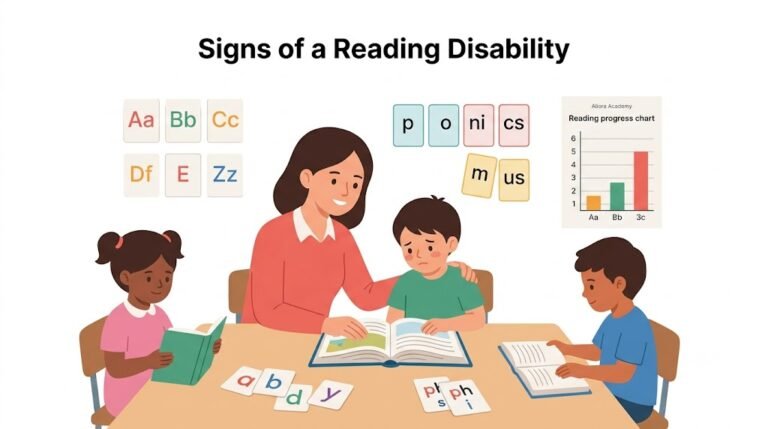
Recognizing these signs early allows you to intervene before the child internalizes the belief that they are simply "bad at reading." For children who show broader reading challenges, you may want to review our guide on signs of a reading disability to understand when difficulties go beyond typical skill development.
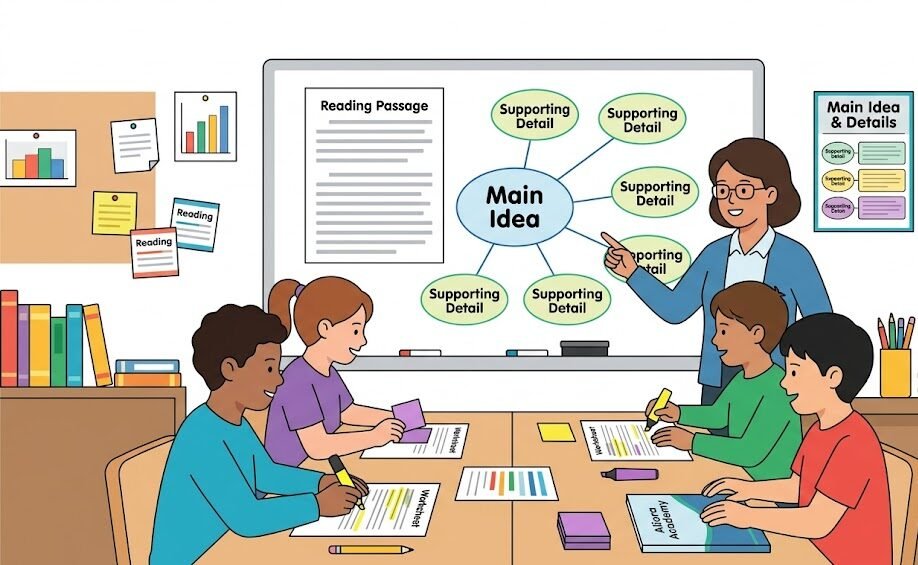
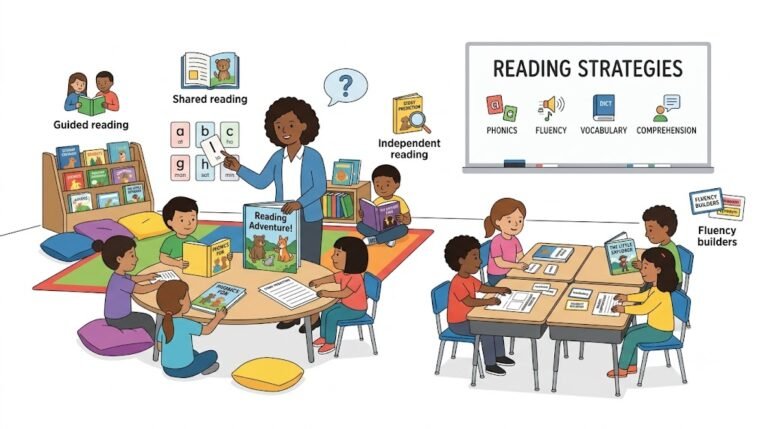
Anchor charts displayed in the classroom give children a constant visual reference for identifying the main idea in any text they read.
How Do You Introduce Main Idea and Supporting Details to Young Learners?
Abstract concepts need concrete introductions. Telling a second grader to "find the main idea" without first building a mental model is like handing them a map with no legend. Start with the familiar and make the invisible visible.
Start with the Umbrella Analogy
One of the most effective introductions is the umbrella analogy. Explain that the main idea is like an umbrella — it covers everything underneath it. The supporting details are the person, the raindrops, the puddles — they all fit under that one big umbrella. This visual metaphor sticks because children can picture it instantly.
Use Sorting Activities
Before applying the concept to text, use physical sorting. Give children a set of picture cards — three dogs, three cats, three birds — and a set of category labels: "Pets," "Animals That Fly," "Animals with Fur." Ask them to sort. Then discuss: "What is the main idea of this group? How do you know?" Sorting builds the cognitive muscle of categorization that main idea identification depends on.
Move to Simple Texts
When children are ready for written text, start with single, well-structured paragraphs where the main idea appears in the first sentence. Nonfiction texts written for young readers often follow this pattern, making them ideal for initial practice. For guidance on selecting appropriate materials, browse our reading resources collection, which includes leveled passages perfect for this stage.
What Are the Best Strategies to Teach Main Idea and Supporting Details?
Once children understand the basic concept, they need systematic strategies they can apply independently. The following approaches have been refined through decades of classroom practice and are effective across grade levels.
The "What-Who-Why" Question Framework
Teach children to ask themselves three questions after reading: What is the topic? Who or what is involved? Why does it matter or what is the author saying about it? The answer to the third question often is the main idea. This framework gives children a repeatable process rather than a vague directive to "figure it out."
Graphic Organizers
A simple main idea graphic organizer — a box at the top for the main idea with three or four boxes underneath for supporting details — transforms an abstract mental process into a concrete visual task. Children fill in the top box first or work upward from the details, depending on how the text is structured. Both approaches strengthen the same underlying skill.
Highlighting with Purpose
Give children two different colored highlighters — one for the main idea and one for supporting details. The act of physically marking the text forces them to make decisions about what is central and what is supporting. This strategy is particularly effective for children who rush through reading without pausing to think about structure. For more classroom-tested approaches, see our article on reading strategies for elementary students.
| Strategy | Best For | How It Helps |
|---|---|---|
| Picture Sorting | Kindergarten – 1st Grade | Builds categorization thinking without requiring reading skills |
| Umbrella Analogy | 1st – 3rd Grade | Creates a lasting visual mental model of the concept |
| What-Who-Why Questions | 2nd – 5th Grade | Provides a repeatable process for any text |
| Graphic Organizers | 2nd Grade and Up | Makes abstract thinking visible and organized |
| Two-Color Highlighting | 3rd Grade and Up | Forces active decision-making while reading |
| Reverse Outlining | 4th Grade and Up | Teaches students to reconstruct the author's organizational plan |
Reverse Outlining
For older elementary students, reverse outlining is a powerful technique. After reading a passage, the child writes a brief phrase next to each paragraph that captures its main point. Then they look across all their margin notes and ask: "What do all of these have in common?" That common thread is the main idea of the entire piece. This strategy bridges the gap between paragraph-level and whole-text comprehension.
How Can Parents Reinforce These Skills at Home?
You do not need a teaching degree to support your child's comprehension growth. A few simple practices woven into daily life can make a significant difference.
Talk About Main Ideas During Read-Alouds
After reading a picture book together, ask casually: "If you had to tell Grandma what this book was mostly about in just two sentences, what would you say?" This low-pressure prompt practices main idea identification without feeling like a quiz. Follow up with: "What parts of the story made you think that?" — and you have just practiced supporting details too.
Use Movies and TV Shows
Narrative comprehension transfers across media. After watching a short episode or movie, ask: "What was the big idea of that story?" Then ask: "What happened that showed you that?" Children often find it easier to identify main ideas in visual media first, and the skill transfers back to print. For children who resist reading altogether, our guide on reading motivation for kids offers additional engagement strategies.
Make It a Game
Turn main idea practice into a guessing game. Read a short paragraph aloud but omit the topic sentence. Can your child guess what the missing sentence says? This activity teaches children that supporting details point toward a central idea — and it feels like play rather than practice.
What Resources Work Best for Teaching Main Idea?
The right materials can accelerate progress significantly. Here is what to look for and what to avoid when selecting resources.
| What to Look For | What to Avoid |
|---|---|
| Passages where the main idea is clearly stated in a topic sentence for beginners | Texts where the main idea is implied but never directly stated — save these for later |
| Short, well-organized paragraphs with one clear focus | Long, meandering passages with multiple competing ideas |
| Graphic organizers with clear, uncluttered layouts | Overly complex organizers with too many boxes and arrows |
| High-interest nonfiction topics that children genuinely want to read about | Dry, generic passages that feel like test prep |
| Workbooks that progress from simple to complex texts | Resources that jump straight to grade-level passages without scaffolding |
If you are looking for structured materials to support this work, our curated list of the best reading comprehension workbooks for elementary students includes options with dedicated main idea sections. Homeschool families may also appreciate our homeschool reading workbooks collection, which features resources designed for one-on-one instruction.
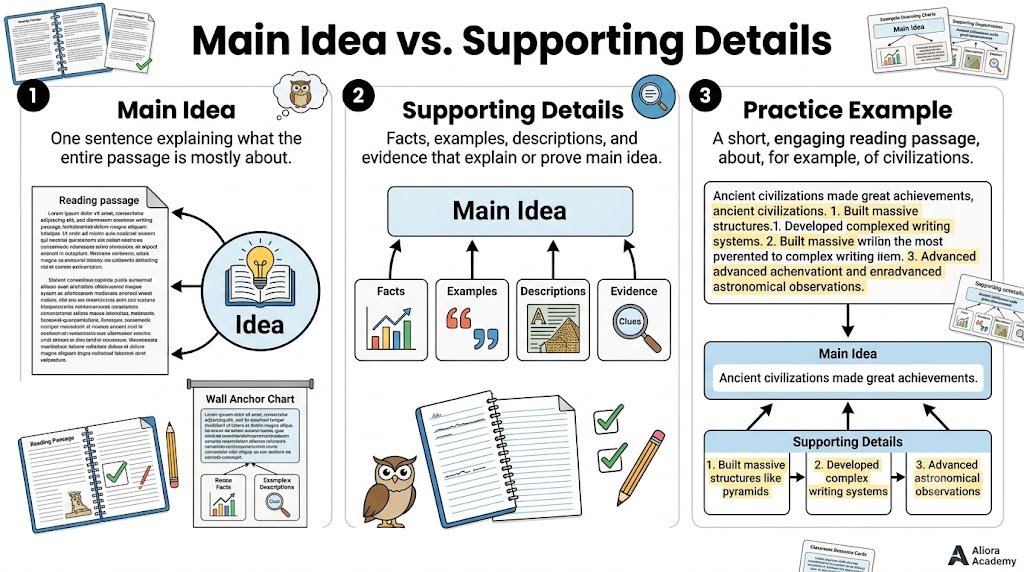
A well-designed workbook page guides children step-by-step from identifying the topic to articulating the main idea.
Common Mistakes to Avoid When Teaching Main Idea
Even experienced educators sometimes fall into these traps. Being aware of them can save time, reduce frustration, and keep learning on track.
Real-Life Examples of Teaching Main Idea and Supporting Details
Example 1: The Detail-Obsessed First Grader
Situation: Emma, age 6, listens to a short story about a girl who loses her tooth at school. When asked what the story was about, she says, "She had a pink backpack."
Challenge: Emma fixates on vivid, concrete details and has not yet developed the concept of a central point. Her brain grabs the most interesting image, not the most important one.
Solution: Her teacher introduced the umbrella analogy with physical props — a small umbrella and picture cards. Together, they sorted which cards "fit under the umbrella" of the story and which were just interesting extras. The visual, hands-on approach made the abstract concept tangible.
Learning Outcome: After three weeks of consistent umbrella activities with progressively more complex stories, Emma began to identify main ideas with about 80 percent accuracy on first attempts.
Takeaway: For young children, concrete metaphors and physical sorting activities bridge the gap between details and main ideas better than verbal explanations alone.
Example 2: The Fourth Grader Who Could Not Summarize
Situation: Marcus, age 10, reads at grade level but cannot write a summary shorter than the original text. His summaries are essentially retellings.
Challenge: Marcus had never been taught to distinguish between essential and nonessential information. He treated every sentence as equally important.
Solution: His tutor introduced two-color highlighting with a clear rule: yellow for the main idea of each paragraph, blue for the most important supporting detail. Then Marcus wrote one sentence combining the yellow and blue highlights. This process taught him to compress information hierarchically.
Learning Outcome: Within two months, Marcus could read a multi-paragraph passage and produce a concise, accurate summary. His confidence in writing assignments improved noticeably.
Takeaway: Summarizing is a teachable skill rooted in main idea identification. The highlighting-to-sentence routine gives children a repeatable process.
Example 3: The Older Student Who Needed Intervention
Situation: Sofia, age 12, has always been a fluent decoder but struggles with comprehension tests. She can read the words smoothly but cannot answer questions about the author's purpose or central message.
Challenge: Sofia had developed what educators call "word calling" — reading words accurately without constructing meaning. Years of focusing on fluency had masked a comprehension gap that widened as texts became more complex. For children with similar profiles, our article on helping a child behind in reading offers additional perspective.
Solution: Her teacher implemented a "stop and jot" routine. After every paragraph, Sofia had to write a three-to-five-word phrase capturing the paragraph's main point. At the end of the article, she reviewed her margin notes and wrote a single sentence synthesizing them. This routine forced active processing at regular intervals.
Learning Outcome: After consistent practice, Sofia's comprehension scores improved, and she reported that reading felt "less foggy" because she had a strategy to anchor her attention.
Takeaway: Fluency without comprehension is a real pattern, especially in older elementary students. Structured annotation routines can close the gap by forcing active engagement.
Frequently Asked Questions About Teaching Main Idea and Supporting Details
At what age should children be able to identify the main idea?
Most children begin developing this skill in first grade with very simple texts and strong teacher support. By third grade, they should be able to identify a clearly stated main idea in a short paragraph with growing independence. Implied main ideas — where the author never states it directly — are typically introduced in fourth or fifth grade as an extension skill.
What is the difference between the main idea and the theme?
The main idea is what the text is mostly about — a specific statement about the topic. Theme is a broader, universal lesson or message that applies beyond the specific text. "A boy learns to stand up to a bully" is a main idea. "Courage comes from within" is a theme. Themes are more abstract and are typically taught later, often beginning in upper elementary grades.
Should I teach main idea using fiction or nonfiction first?
Nonfiction texts, especially well-organized articles and informational books, usually present clearer main idea structures. The main idea often appears in the first or last sentence of a paragraph. Starting with nonfiction gives children a higher success rate and builds confidence before they tackle the more nuanced structures of fiction.
How do I help a child who always picks the first sentence as the main idea?
This is a common phase. While the first sentence often contains the main idea, it does not always. Provide passages where the main idea appears in the middle or at the end. Discuss why the first sentence is not always the winner. Over time, children learn to evaluate the whole paragraph rather than defaulting to the first line.
Can graphic organizers really make a difference?
Yes — especially for children who struggle with abstract thinking. Graphic organizers externalize the mental process of sorting and prioritizing information. They give children a clear place to put each piece of information, which reduces cognitive load. Many teachers report that reluctant readers engage more willingly when they have a visual framework to complete. For children who need extra support with reading engagement, our reading motivation guide offers complementary strategies.
What if my child understands the main idea but cannot find supporting details?
This pattern sometimes indicates that the child is relying on background knowledge or guessing rather than reading closely. Try the "prove it" strategy: when your child states a main idea, say gently, "Prove it — show me the words in the text that made you think that." This redirects attention back to the text evidence without dismissing their thinking.
How much practice does a child need to master this skill?
There is no fixed timeline, but consistency matters more than intensity. Short, focused practice sessions — ten to fifteen minutes, three or four times per week — produce better results than occasional long sessions. Most children show noticeable improvement within six to eight weeks of consistent, targeted practice with appropriate texts.
Are there specific books that work especially well for teaching main idea?
Yes. Look for books with clear structures: how-to books, animal fact books, short biographies, and other nonfiction with explicit topic sentences. For struggling readers, choosing books at the right level is essential. Our guide to the best books for struggling 4th grade readers includes titles that support comprehension skill development at accessible reading levels.
Building a Foundation That Lasts a Lifetime
Teaching a child to identify the main idea and supporting details is not about checking off a standard or passing a test. It is about giving them a lens through which to view every text they will ever encounter — a way of asking, "What matters here, and how do I know?" That question, practiced until it becomes automatic, transforms reading from a passive activity into an active, critical, and deeply satisfying pursuit.
The strategies in this guide — the umbrella analogy, the sorting activities, the graphic organizers, the highlighting routines — all serve the same purpose: to make the invisible process of comprehension visible and teachable. None of them require special training or expensive materials. What they require is patience, consistency, and a belief that every child can learn to read with understanding.
Progress may come in small increments. A child who could only name the topic begins to offer a full main idea sentence. A child who highlighted everything starts to highlight strategically. A child who dreaded "what's the main idea" questions begins to answer with confidence. Celebrate each of these moments. They are evidence that the framework is taking hold.
For continued support, explore our reading resources for workbooks and activities designed to strengthen comprehension skills, visit our blog for more literacy guidance, or browse our homepage to see our full collection of educational tools. If you have questions about finding the right resources for your child or classroom, we invite you to contact us — we are always happy to help.
Every time you sit beside a child and ask, "What was that really about?" you are doing more than teaching a reading skill. You are teaching them to look for what matters. And that habit of mind will serve them long after the last book is closed.