Signs of a Reading Disability in Elementary Students
Recognizing the early indicators, understanding what they mean, and knowing how to respond with confidence and care.
Browse Reading Resources
Noticing subtle reading behaviors early can open the door to timely, effective support for elementary students.
Every child learns to read at a different pace, and some degree of uneven progress is completely normal during the elementary years. But when a child consistently struggles — week after week, despite regular practice and classroom instruction — parents and teachers often begin to wonder whether there is something more going on beneath the surface. Understanding the signs of a reading disability is not about labeling a child; it is about recognizing patterns that may indicate a need for a different kind of support.
Reading disabilities, including dyslexia, are far more common than many people realize. They are not tied to intelligence, motivation, or how often a child is read to at home. They are brain-based differences in how individuals process written language. When these differences are identified early, children can receive targeted instruction that works with their unique learning profile — and outcomes improve dramatically.
This guide explains the most common signs of a reading disability across the elementary grades, breaks down what those signs may mean, and offers practical guidance for parents and educators who want to take the next step. For a broader look at reading development and support strategies, explore our blog where we cover everything from foundational literacy to advanced comprehension.
What Is a Reading Disability?
A reading disability is a specific learning difference that affects a child's ability to read accurately, fluently, or with adequate comprehension. It is not a reflection of cognitive ability, and it is not something a child outgrows without intervention. The most widely known reading disability is dyslexia, which primarily affects word recognition, decoding, and spelling. Other reading disabilities may involve difficulties with reading comprehension, reading fluency, or a combination of these areas.
Reading disabilities exist on a spectrum. Some children struggle profoundly with sounding out even simple words, while others can read aloud reasonably well but retain very little of what they have read. Both scenarios can signal an underlying issue that deserves attention. It is also important to note that reading disabilities often co-occur with other learning differences, such as attention challenges or written expression difficulties.
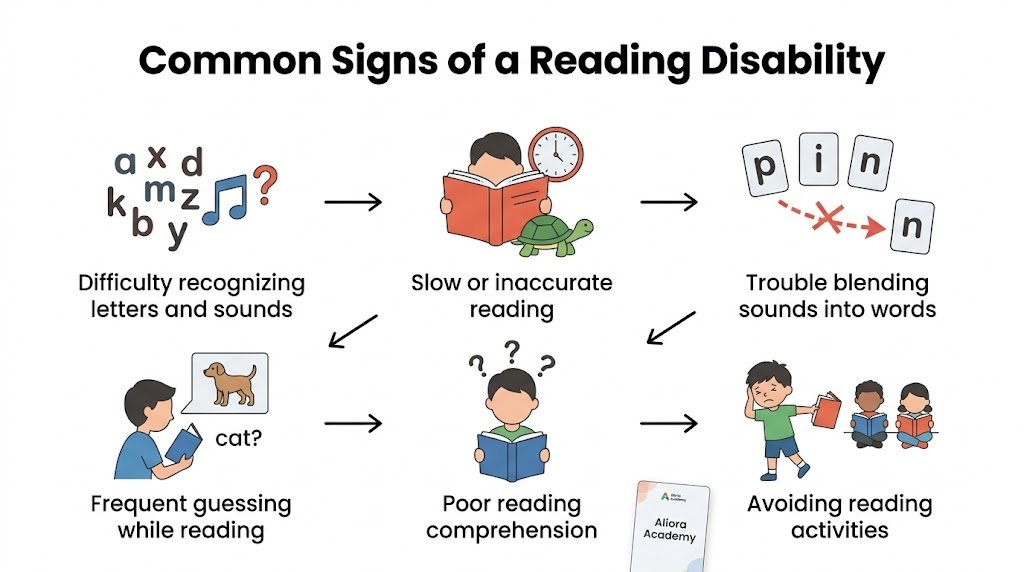
For some children, printed text can feel confusing or overwhelming — a potential indicator worth investigating further.
What Are the Early Signs of a Reading Disability in Kindergarten and First Grade?
The earliest indicators often appear long before a child is expected to read independently. In kindergarten and first grade, the focus is on building the foundational skills that support later reading success. When these building blocks do not come together as expected, it is worth paying close attention.
Watch for these early warning signs:
- Difficulty recognizing rhyming words — A child who cannot tell that "cat" and "hat" sound alike may have weak phonemic awareness.
- Trouble learning letter names and sounds — Persistent confusion between similar-looking letters such as b and d or similar-sounding letters such as f and v.
- Inability to break words into syllables — Struggling to clap out the parts of simple words like "el-e-phant."
- Difficulty remembering sight words — Words that have been practiced repeatedly still do not seem to stick.
- Avoidance of reading-related activities — Complaints that reading is too hard, or finding excuses to do something else.
- Family history of reading difficulties — Reading disabilities often run in families, so a parent or sibling with similar struggles raises the likelihood.
A single sign on this list is not cause for alarm. But when several signs cluster together and persist beyond the initial adjustment to school, a closer look is warranted. Building reading confidence in kids during these early years is especially important, as early frustration can shape a child's self-perception as a learner for years to come.
How Do Signs of a Reading Disability Change in Second and Third Grade?
As children move into second and third grade, the demands of reading increase significantly. The focus shifts from learning to read toward reading to learn. This transition often brings hidden difficulties to the surface — children who managed to compensate in earlier grades may suddenly find themselves falling behind.
At this stage, look for:
- Slow, laborious reading aloud — The child reads word by word without natural phrasing or expression.
- Heavy reliance on guessing — Instead of sounding out unfamiliar words, the child guesses based on the first letter or the pictures.
- Frequent word substitutions — Saying "house" for "home" or "puppy" for "dog," which changes the meaning of the sentence.
- Poor spelling that persists — Misspelling the same common words repeatedly, even after correction.
- Avoidance of independent reading — Choosing books far below grade level or gravitating only toward heavily illustrated books.
- Difficulty retelling a story — The child can read a passage but cannot summarize it in their own words. For more on this specific challenge, read about what to do when a child is behind in reading.
What Are the Signs of a Reading Disability in Upper Elementary Grades?
By fourth and fifth grade, students are expected to read for extended periods, synthesize information from multiple sources, and engage with more complex vocabulary and sentence structures. Children with undiagnosed reading disabilities often develop elaborate coping strategies to mask their difficulties — and those strategies can make the problem harder for adults to spot.
Signs that may emerge in upper elementary include:
- Extremely slow reading speed — Assignments that should take 20 minutes stretch into an hour or more.
- Difficulty with content-area reading — Struggling to read science, social studies, or math word problems despite strong verbal ability in class discussions.
- Written expression that lags behind verbal expression — A child who can tell a rich, detailed story orally but produces only a few sparse sentences on paper.
- Anxiety or behavioral resistance around reading — Tears, anger, or withdrawal when reading tasks arise.
- Reliance on audiobooks or having others read aloud — While audiobooks are valuable tools, using them exclusively to avoid any visual reading can be a red flag.
- Declining self-esteem and school avoidance — Statements like "I'm just dumb" or "I hate school" may signal deep reading-related frustration.
At this stage, parents may also want to compare the effectiveness of different learning tools. Our guide on reading apps vs. workbooks can help you decide which format best supports a child who needs additional practice at home.
Is Poor Reading Comprehension Always a Sign of a Reading Disability?
Not always, but it can be. Comprehension difficulties fall into two broad categories. The first occurs when a child cannot decode the words accurately enough to access meaning — the brain is spending so much energy on figuring out the words that no capacity remains for understanding. The second occurs when a child can read the words fluently but still struggles to grasp the overall meaning, infer character motivations, or connect ideas across paragraphs.
The first type is often rooted in a decoding-based reading disability such as dyslexia. The second type may be related to a specific comprehension deficit, language processing challenges, or limited background knowledge and vocabulary. Both deserve investigation. For structured practice materials that target comprehension skills, see our recommendations for the best reading comprehension workbooks for elementary students.
Decoding vs. Comprehension: Two Different Challenges
| Decoding-Based Difficulty | Comprehension-Based Difficulty |
|---|---|
| Child struggles to sound out words accurately | Child reads words accurately but misses the meaning |
| Reading aloud is slow, hesitant, and full of errors | Reading aloud may sound smooth but mechanical |
| Spelling is often significantly below grade level | Spelling may be adequate or even strong |
| Often associated with dyslexia | May be associated with language processing or attention differences |
| Responds well to structured, systematic phonics instruction | Responds well to explicit vocabulary and comprehension strategy instruction |
What Behaviors Might Mask a Reading Disability?
Children are remarkably resourceful at hiding what feels shameful to them. Many students with undiagnosed reading disabilities develop avoidance tactics and compensatory behaviors that can fool even experienced teachers and attentive parents — at least for a while.
Behaviors that may serve as masks include:
- Memorizing entire books — The child appears to read but is actually reciting from memory after hearing the story repeatedly.
- Using pictures to guess text — Relying heavily on illustrations to supply meaning rather than decoding the words themselves.
- Acting out or becoming the class clown — Disruptive behavior during reading time can be a diversionary tactic.
- Excessive perfectionism — Erasing and rewriting repeatedly, or refusing to attempt a word unless certain of it.
- Complaints of physical discomfort — Headaches, stomachaches, or tiredness that conveniently arise during reading tasks.
- Deflecting praise — Dismissing compliments about reading progress because the child internally believes they are not truly capable.
A supportive, unhurried environment at home can make all the difference when a child is struggling with reading.
How Should Parents Respond If They Notice Signs of a Reading Disability?
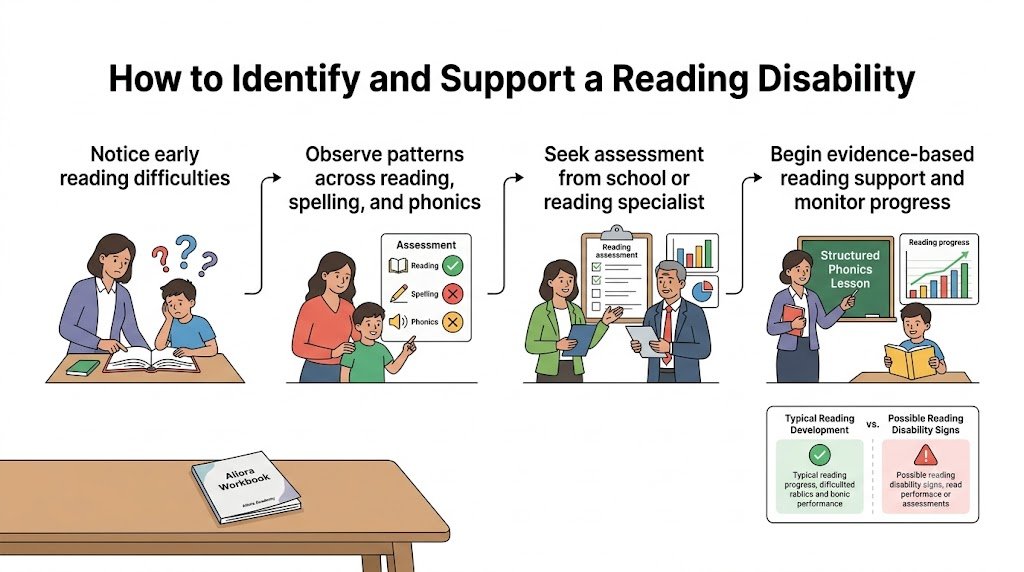
Noticing the signs can bring a flood of emotions — worry, guilt, uncertainty about what to do next. The most important first step is to stay calm and gather information. A measured, informed response serves your child far better than a rushed or anxious one.
Start with the Classroom Teacher
Schedule a conversation with your child's teacher to share what you are observing at home and ask what they are seeing in the classroom. Teachers often have valuable perspective on how a child's reading compares to grade-level expectations and to same-age peers. Come prepared with specific examples: "He avoids reading aloud at home" or "She confuses similar-looking words consistently." These details help the teacher build a fuller picture.
Document What You Observe
Keep informal notes on what you notice over a few weeks. Patterns matter more than isolated incidents. Does your child struggle more when tired? Are certain types of words consistently difficult? Does comprehension break down with longer passages but not shorter ones? This documentation can be invaluable if you later pursue a formal evaluation.
Explore Supportive Resources at Home
While you are gathering information, you can begin incorporating gentle, targeted practice at home. The key is to keep sessions short, positive, and focused on one skill at a time. For guidance on creating a productive home practice routine, explore our collection of parent reading strategies. If you are homeschooling, you may find our recommendations for homeschool reading workbooks particularly useful for structured, sequential practice.
When Should You Seek a Professional Evaluation?
Deciding when to pursue formal testing is a deeply personal decision, but certain circumstances strongly suggest that an evaluation is warranted. Trust your instincts — if your gut tells you something is not right, it is worth investigating.
Consider an evaluation when:
- Reading struggles have persisted for six months or more despite consistent classroom instruction and home support.
- The gap between your child's reading level and grade-level expectations is widening rather than narrowing.
- There is a family history of dyslexia or other learning differences.
- Your child's self-esteem, mood, or behavior has changed noticeably in connection with reading demands.
- A teacher or pediatrician has recommended further assessment.
- Your child is working significantly harder than peers to achieve the same reading results.
Evaluations are typically conducted by school psychologists, educational psychologists, or neuropsychologists. They assess a range of reading-related skills — phonemic awareness, decoding, fluency, comprehension, and related cognitive processes — to determine whether a reading disability is present and to inform recommendations for instruction and accommodations.
Real-Life Examples of Recognizing Signs of a Reading Disability
Example 1: The Kindergarten Puzzle
Situation: Noah, age 5, loves being read to and can retell stories in impressive detail. But when his kindergarten teacher introduces letter sounds, Noah seems confused. After several weeks, he still cannot reliably name more than a handful of letters, and rhyming games leave him guessing randomly.
Challenge: Noah's strong verbal memory had masked his weak phonemic awareness. Because he could discuss stories so well, no one initially suspected an underlying issue with sound-symbol connections.
Solution: Noah's parents and teacher collaborated to provide daily, multisensory phonemic awareness activities — clapping syllables, sorting pictures by beginning sound, and playing oral blending games. They also began monitoring his progress more closely to determine whether additional intervention was needed.
Learning Outcome: With early, targeted support, Noah's phonemic awareness improved steadily. The early identification allowed his team to intervene before he experienced significant failure in first grade.
Takeaway: Strong verbal skills can hide weak phonological processing. Pay attention to how a child interacts with sounds — not just how well they understand stories.
Example 2: The Third-Grade Wall
Situation: Ava, age 8, managed to keep up with reading through second grade by memorizing sight words and using context clues. In third grade, as texts grew longer and more complex, her strategies began to fail. She started saying she hated reading and her grades dropped.
Challenge: Ava had never developed strong decoding skills. She had been relying on her excellent memory and intelligence to compensate, but the increased demands of third-grade text exceeded what compensation alone could handle.
Solution: A reading specialist assessed Ava and identified gaps in her phonics knowledge, particularly with vowel teams and multisyllabic words. She began a structured literacy program that explicitly taught these patterns in a logical sequence. At home, her parents used decodable texts that matched her instructional level rather than her frustration level.
Learning Outcome: Within a semester, Ava's decoding accuracy improved markedly. More importantly, her willingness to read returned as the task became less exhausting. She began to see herself as a capable reader again.
Takeaway: The transition to third grade is a common point at which compensatory strategies break down. A decoding assessment can reveal gaps that were previously hidden by strong memorization skills.
Example 3: The Fifth-Grade Avoider
Situation: Liam, age 10, has always been a reluctant reader, but his fifth-grade teachers notice something new — he has become a master of avoidance. He volunteers for errands during independent reading, asks to use the restroom, and has developed a sudden interest in organizing the classroom library instead of reading the books. His oral contributions in class are insightful, but his written work is sparse and his reading scores are far below benchmark.
Challenge: Years of undiagnosed reading difficulty had taught Liam that reading was a source of embarrassment. His coping mechanisms were sophisticated and had kept adults from fully recognizing the depth of his struggle.
Solution: Liam's parents requested a comprehensive evaluation, which revealed a significant discrepancy between his verbal comprehension and his reading fluency. The diagnosis allowed him to receive accommodations — including extended time and the option to use text-to-speech for content-area reading — while also beginning intensive fluency intervention.
Learning Outcome: With the right supports in place, Liam's academic performance began to align with his obvious intellectual ability. His avoidance behaviors decreased as reading became less threatening, and he discovered a love for audiobooks that eventually led him back to printed text.
Takeaway: By upper elementary, avoidance can look like a behavioral issue when it is actually a reading issue. Look behind the behavior to find the root cause, and do not hesitate to pursue an evaluation even for older elementary students — it is never too late to provide effective support.
How Can You Support Reading Development While Seeking Answers?
The period between noticing signs and obtaining a formal diagnosis can feel like limbo. But there is plenty you can do during this time to support your child's reading development and emotional well-being. Developing consistent elementary reading habits benefits every child, whether or not a disability is present.
Focus on these areas while you wait:
- Protect your child's self-esteem above all else. Make sure they know that reading difficulty is not a measure of intelligence or worth.
- Keep reading aloud. Continue exposing your child to rich vocabulary, complex ideas, and the pleasure of a good story through your own voice.
- Offer audiobooks. Let your child access content at their intellectual level even while their decoding skills catch up.
- Practice in short, successful bursts. Ten minutes of focused, positive practice is far more effective than an hour of frustration.
- Celebrate every step forward. Noticing and naming progress — however small — builds the motivation to keep trying.
Frequently Asked Questions About Signs of a Reading Disability
At what age can a reading disability be reliably identified?
Early signs can appear in preschool and kindergarten, but formal diagnoses are typically most reliable around age 6 or 7, after a child has had some exposure to formal reading instruction. However, waiting for a formal diagnosis is not necessary to begin providing support — early intervention based on observed difficulties is beneficial regardless of whether a label is ultimately assigned.
Can a child have a reading disability even if they are gifted in other areas?
Absolutely. Many children with reading disabilities are intellectually gifted, a profile sometimes referred to as twice-exceptional. Their strong cognitive abilities can mask their reading difficulties for years, and their reading difficulties can prevent them from demonstrating their true capabilities. This combination can be particularly frustrating for the child and confusing for adults.
Is dyslexia the only type of reading disability?
Dyslexia is the most common and well-known reading disability, primarily affecting word recognition, decoding, and spelling. However, other reading disabilities exist, including specific reading comprehension deficits where a child can decode words accurately but struggles to understand connected text. Some children also have mixed reading difficulties affecting both decoding and comprehension.
Do reading disabilities run in families?
Yes, there is a strong genetic component to reading disabilities, particularly dyslexia. If a parent or sibling has a diagnosed reading disability, the likelihood that a child will also have one is significantly higher. This family history is an important piece of information to share with teachers and evaluators.
Can a reading disability be cured?
Reading disabilities are lifelong neurological differences — they are not something that can be cured in the traditional sense. However, with appropriate, structured instruction and accommodations, individuals with reading disabilities can learn to read accurately and develop strategies that allow them to succeed academically and professionally. Early, evidence-based intervention yields the strongest outcomes.
What is the difference between a reading delay and a reading disability?
A reading delay typically means a child is progressing more slowly than peers but is following a typical developmental trajectory and will likely catch up with time and support. A reading disability involves a persistent difficulty that does not resolve with standard instruction and requires specialized, structured intervention. Only a comprehensive evaluation can distinguish between the two with confidence.
Should I tell my child they have a reading disability?
Most experts recommend age-appropriate honesty. Children often feel relieved to learn that their struggle has a name and that it is not their fault. Framing a reading disability as a difference in how their brain processes written language — not a flaw or a failure — can be empowering. Focus on strengths, explain that many successful people have similar learning differences, and emphasize that the right support will help them succeed.
Where can I find trusted resources to support a child with a reading disability?
Start by exploring the reading resources collection on our website, which includes materials designed for children who need structured, sequential practice. Our homepage offers a gateway to a wide range of educational tools and articles. For personalized guidance, you can also contact us directly with questions about finding the right resources for your child's specific needs.
Moving Forward with Knowledge and Compassion
Recognizing the signs of a reading disability in an elementary student is not the end of a story — it is the beginning of a new, more informed chapter. When parents and teachers understand what they are seeing, they can move past confusion and frustration into purposeful action. The goal is not to label a child but to unlock the door to the right kind of support.
Every child deserves to experience reading as a source of confidence rather than a source of shame. Whether the path forward involves a formal evaluation, structured literacy intervention, classroom accommodations, or simply a more patient and informed approach at home, the most important ingredient is a caring adult who believes in the child's potential and refuses to give up.
If you are at the start of this journey, take heart. The resources and knowledge available today are far greater than they were even a generation ago. Browse our reading category for materials designed to meet children where they are, revisit our blog for ongoing guidance, and reach out through our contact page if you need help navigating the options. You are not walking this road alone, and with the right support, your child can become the reader they were meant to be.