Why Is My Child Behind in Reading? Common Reasons and Help
Understand the real reasons reading gaps develop, learn how to support your child at home, and discover which resources can help them catch up with confidence.
Explore Reading Resources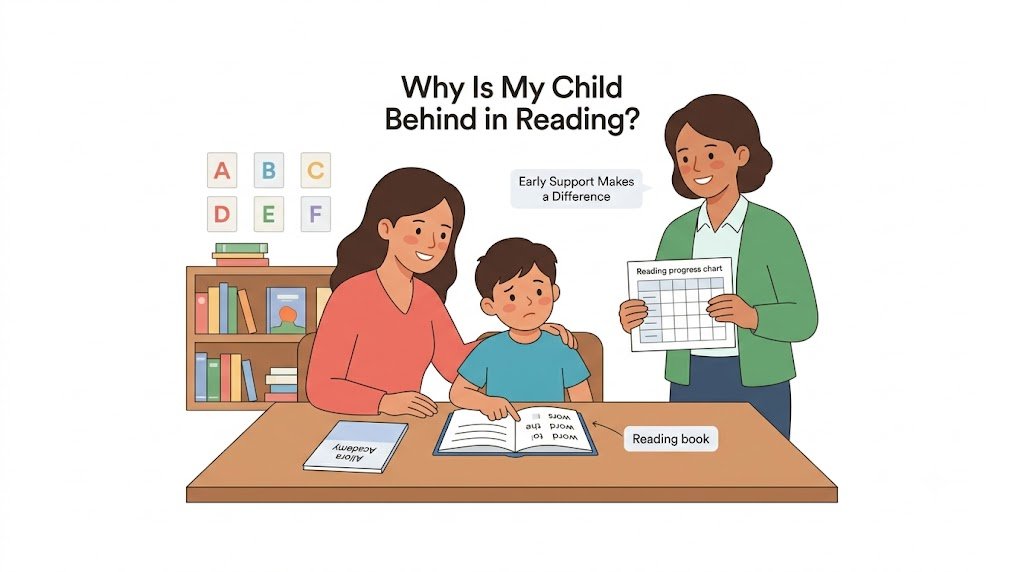
A quiet, pressure-free reading environment is often the foundation for meaningful progress.
Noticing that your child is behind in reading can stir up a mix of worry, guilt, and urgency. You might wonder if you missed something, if the school is doing enough, or if there's a deeper issue that needs attention. These feelings are both common and understandable. The good news is that reading delays are rarely permanent — and with the right approach, most children can close the gap and develop into capable, engaged readers.
Understanding why your child is behind in reading is the essential first step. Reading development is a complex process that depends on several interconnected skills. When one or more of these skills lags, the entire reading experience can become difficult. The key is to identify which areas need support and address them in a way that feels safe, encouraging, and consistent.
This guide explores the common reasons children fall behind, the signs to watch for, and the most effective ways to help — whether you're a parent, teacher, or homeschool educator. For more foundational reading insights, visit our blog, where we cover a wide range of early literacy topics.
Why Do Some Children Fall Behind in Reading?
Reading is not a single skill but a layered process that builds from the ground up. When a child falls behind, the root cause usually sits within one or more of these foundational layers. Understanding these layers helps you target support precisely where it's needed most.
The Building Blocks of Reading
The ability to hear, identify, and manipulate individual sounds in spoken words — such as knowing that "cat" is made of /c/ /a/ /t/. This is an auditory skill and the foundation for all phonics work.
Connecting written letters to their sounds and blending those sounds to read words. A child with weak decoding skills often guesses or relies heavily on pictures.
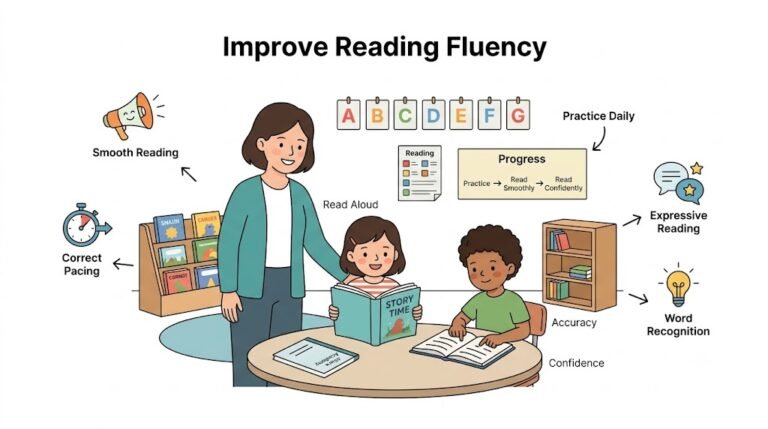
The ability to read accurately, at a natural pace, and with expression. Fluency acts as the bridge between decoding words and understanding them. When reading is slow and laborious, comprehension suffers.
Knowing the meaning of words encountered in text. A limited vocabulary makes it hard to understand even accurately decoded sentences.
The ultimate goal: making meaning from text, connecting ideas, drawing inferences, and thinking critically about what was read. For a closer look at strengthening this skill, see our guide on the best reading comprehension workbooks for elementary students.
A child who is behind in reading may have a gap in any of these areas. Often, multiple layers need attention simultaneously. The most effective support starts by identifying which building blocks are shaky and reinforcing them with targeted practice.
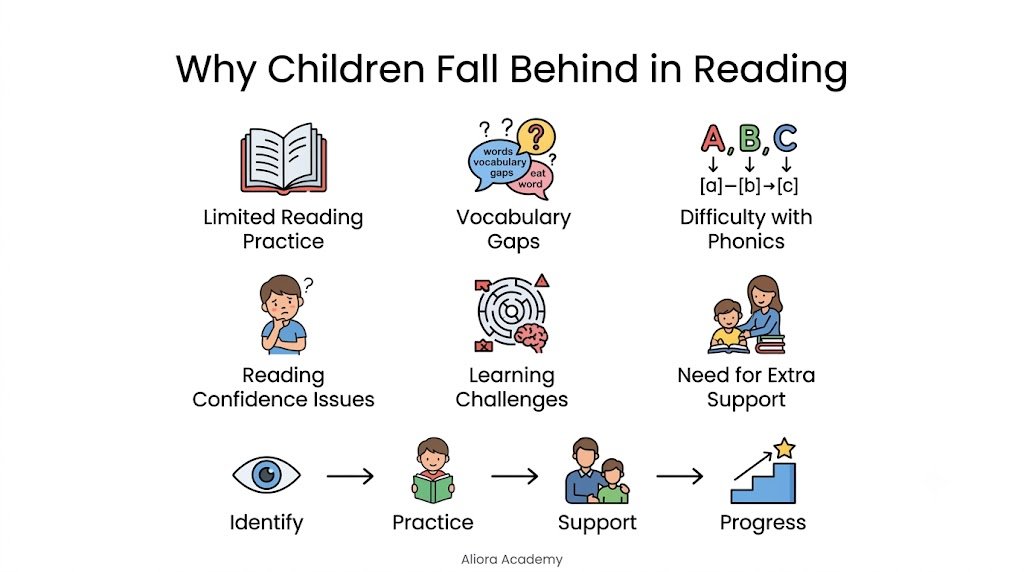
Recognizing signs of frustration early helps parents and teachers adjust their approach before avoidance patterns set in.
What Are the Warning Signs Your Child Is Behind in Reading?
Children rarely announce that they're struggling with reading. Instead, they often communicate difficulty through behavior. Recognizing these signs early allows you to intervene before a temporary gap becomes a long-term struggle.
Watch for these common indicators:
- Avoidance behaviors — making excuses to stop reading, suddenly needing a drink or a bathroom break whenever reading time starts.
- Guessing words — relying on the first letter or the pictures rather than sounding words out.
- Frustration or tears — becoming visibly upset, angry, or anxious when asked to read.
- Flat, robotic reading — reading word by word with no expression or natural phrasing.
- Inability to retell — finishing a passage but being unable to explain what happened, even in simple terms.
- Forgetting sight words — struggling to recognize high-frequency words that should be automatic by their grade level.
- Calling books "boring" — a common defense mechanism when reading feels too hard.
What Are the Most Common Reasons a Child Falls Behind in Reading?
Understanding the "why" behind the struggle helps you choose the right strategy. Here are the most frequent reasons children fall behind, based on well-established educational experience and classroom observation.
✅ Skill-Based Causes
- Gaps in phonemic awareness that were never fully addressed
- Incomplete phonics instruction or too-rapid progression
- Insufficient fluency practice leading to slow, choppy reading
- Limited exposure to rich vocabulary at home or school
- Weak comprehension monitoring — not realizing when meaning breaks down
⚠️ Environmental & Emotional Factors
- Reading anxiety from past negative experiences
- Limited access to engaging, level-appropriate books
- Inconsistent reading practice or frequent interruptions
- Undiagnosed learning differences such as dyslexia
- Attention challenges that make sustained reading difficult
Many children experience a combination of skill gaps and emotional factors. A child who struggled with phonics in first grade may develop reading anxiety by third grade — even if their decoding skills have improved. Addressing both the skill and the emotional response is essential for lasting progress. Our guide on building reading confidence in kids explores the emotional side of reading support in more depth.
How Can You Help a Child Who Is Behind in Reading at Home?
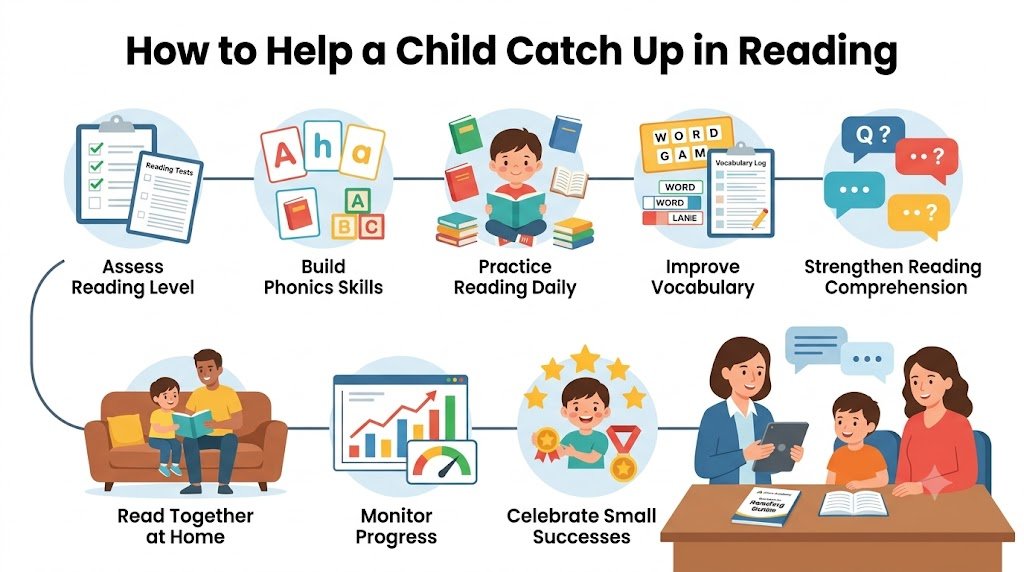
You don't need a teaching credential to make a meaningful difference. The most powerful support often happens in short, consistent, low-pressure sessions at home. Here are practical strategies that work across grade levels.
Create a Judgment-Free Reading Routine
Children who are behind in reading are often acutely aware of their struggles. They may feel embarrassed, especially if they compare themselves to siblings or classmates. The single most important thing you can do is make reading time feel safe. Let your child know that mistakes are part of learning — not something to be ashamed of.
Use Echo and Paired Reading
Echo reading involves you reading a sentence aloud with expression, then having your child echo it back. Paired reading means reading together in unison, with your voice gradually fading as your child gains confidence. Both techniques model fluent reading without the pressure of solo performance. They're simple, effective, and require no special materials.
Focus on One Skill Per Session
It's tempting to correct every mistake, but constant interruption can overwhelm a struggling reader. Instead, choose one focus area per session. Today, you might only pay attention to vowel sounds. Tomorrow, you might work on reading with expression. This targeted approach feels manageable and builds specific skills faster than scattered correction.
Keep Reading Aloud — Even to Older Children
Many parents stop reading aloud once their child can read independently. But listening to fluent reading is one of the most powerful supports you can offer. It models pacing, expression, and vocabulary — and it keeps reading enjoyable. Continue reading aloud to your child well into the elementary years and beyond. For more ideas, see our parent reading strategies guide.
What Strategies Do Teachers Use to Support Struggling Readers?
Teachers have the advantage of structured instructional time and access to specialized materials. The strategies below are widely used in classrooms and tutoring settings because they are backed by decades of practical experience and reading research.
Explicit, Systematic Phonics Instruction
For children with decoding difficulties, a structured phonics program that moves step by step — from simple letter-sound relationships to more complex patterns — is often the most effective approach. Unlike incidental phonics, which teaches skills as they come up in random texts, systematic instruction ensures no gaps are left unaddressed.
Multisensory Learning Techniques
Engaging multiple senses strengthens memory connections. Have children trace letters in sand while saying the sound, tap out syllables on their arm, or build words with magnetic tiles. These techniques are especially helpful for children who learn differently and need more than just visual or auditory input.
Repeated Reading for Fluency
Choose a short passage at the child's instructional level. Have them read it several times over a few days, tracking their accuracy and speed. Repeated reading builds automaticity — the ability to recognize words instantly — which frees up cognitive energy for comprehension. It's one of the simplest and most evidence-backed fluency strategies available.
If you're a homeschool parent looking for structured materials to support these strategies, our homeschool reading workbooks guide can help you find the right fit for your child's needs.
How Do You Choose the Right Reading Materials for a Child Who Is Behind?
One of the most common mistakes is giving a struggling reader books at their grade level rather than their instructional level. A child who reads at a second-grade level but is in fourth grade needs high-interest, accessible texts — not fourth-grade chapter books that lead to frustration.
When selecting reading materials, prioritize these features:
- High-interest content at a lower reading level — Engaging topics that don't feel babyish.
- Controlled vocabulary — Words that follow predictable patterns the child has been taught.
- Short passages or chapters — Build stamina gradually with manageable chunks.
- Clear, uncluttered page layouts — Avoid busy designs that distract or overwhelm.
- Audio support options — Audiobooks paired with print can be a game-changer for comprehension.
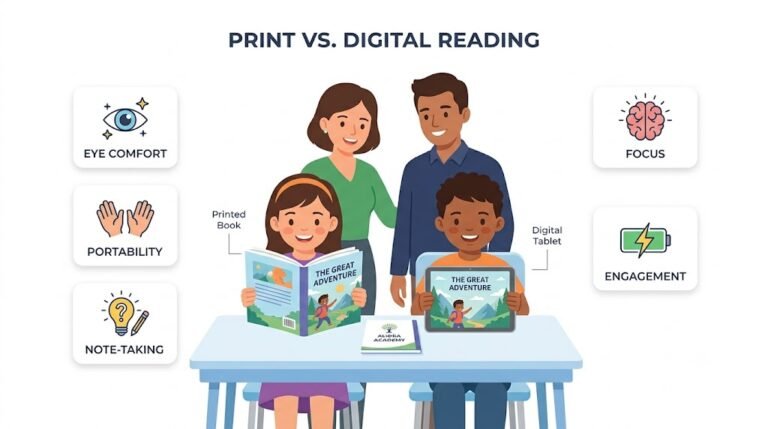
Deciding between digital tools and traditional workbooks can also be part of the equation. Our comparison of reading apps vs. workbooks breaks down the strengths and limitations of each format so you can make an informed choice. You can also browse our full reading resources collection for materials organized by skill level and grade.
The right materials — matched to a child's instructional level and interests — can transform reading from a chore into an experience they look forward to.
Real-Life Examples of Helping a Child Behind in Reading
Example 1: The Kindergarten Gap
Situation: Ethan, age 5, entered kindergarten excited about school but quickly fell behind his peers in letter recognition and sound awareness. His teacher mentioned he struggled during phonics activities.
Challenge: Ethan had limited preschool exposure to rhyming games, letter play, and read-alouds. His phonemic awareness — the ability to hear sounds within words — was underdeveloped compared to classmates who had more early literacy experience.
Solution: His parents began incorporating playful sound games into daily routines — clapping out syllables at the breakfast table, playing "I Spy" with beginning sounds during car rides, and reading rhyming picture books together every evening. They kept sessions short, playful, and pressure-free.
Learning Outcome: Within three months, Ethan's letter-sound knowledge caught up to grade-level expectations. The daily, low-stakes practice gave him the repetition he needed without triggering anxiety.
Takeaway: For young children, closing early gaps often requires more playful exposure — not more formal instruction. Short, consistent, game-like practice works wonders.
Example 2: The Mid-Elementary Fluency Stall
Situation: Maya, age 8, could decode words accurately but read so slowly that she lost the thread of every passage. Her third-grade teacher noted that Maya's comprehension scores were dropping — not because she couldn't understand, but because she expended all her energy on getting the words right.
Challenge: Maya's reading lacked automaticity. Every word required conscious effort, leaving no mental bandwidth for meaning. She needed fluency work, not more comprehension worksheets.
Solution: Her teacher and parents coordinated a repeated reading routine. Maya read the same short passage three times across three days, charting her speed and accuracy. The passages were at her independent level so she could experience success. Her parents also began echo reading with her at bedtime, modeling expressive, phrased reading.
Learning Outcome: After eight weeks, Maya's reading rate improved significantly, and her comprehension scores followed. She began to describe reading as "easier" and voluntarily picked up books during free time.
Takeaway: When fluency is the bottleneck, targeted repeated reading — not more comprehension instruction — is often the most efficient path forward.
Example 3: The Older Child Who Disengaged Completely
Situation: James, age 11, told his parents he "hated reading" and refused to pick up any book that wasn't required for school. His reading scores had been below benchmark for two years, and he had internalized the belief that he simply wasn't a reader.
Challenge: Years of difficulty had created deep reading avoidance. James associated books with failure and embarrassment. He needed to experience reading as something rewarding before any skill work could stick.
Solution: His parents took a radical approach — they stopped all required reading for one month. Instead, they leaned into audiobooks paired with graphic novels on topics James already loved: space exploration and adventure stories. They listened together during car rides and discussed the stories casually, with no quizzes or comprehension checks. Gradually, James began following along in the printed graphic novels while listening.
Learning Outcome: By the end of three months, James had consumed six graphic novels and two full audiobooks. His stamina for printed text increased because the content was genuinely interesting and the format felt accessible. He began to refer to himself as "someone who likes stories" — a significant identity shift.
Takeaway: For older children who are behind in reading, rebuilding identity and motivation often must come before skill intervention. Audiobooks and graphic novels are legitimate, powerful gateways.
How Can You Build Strong Reading Habits That Last?
Helping a child catch up is important — but helping them develop lasting reading habits is transformative. Children who read regularly, even in small doses, continue to grow their skills long after formal intervention ends. For practical habit-building strategies, explore our guide on building elementary reading habits, which covers routines, motivation, and creating a reading-friendly home environment.
When Should You Consider Professional Intervention?
Many reading struggles respond well to consistent home and classroom support. But some children need more specialized help. Knowing when to seek additional evaluation can save months of frustration.
Consider reaching out to a reading specialist or educational psychologist if:
- Your child has received consistent, targeted support for several months with little to no measurable progress.
- There is a family history of dyslexia or other language-based learning differences.
- Your child shows a significant gap between their verbal intelligence and their reading performance.
- Reading avoidance is affecting their overall attitude toward school and learning.
- A teacher has specifically recommended further assessment.
If you have questions about finding the right resources or next steps, please contact us. We're here to help you navigate the options and find materials that match your child's specific needs. You can also visit our homepage for a complete overview of our educational resources and guides.
Frequently Asked Questions
How do I know if my child is truly behind or just developing at their own pace?
Some variation in reading development is completely normal. Concern is warranted when your child consistently performs below grade-level benchmarks, shows visible frustration or avoidance, and does not respond to consistent support over several months. A conversation with your child's teacher is often the best place to start — they can provide context about where your child stands relative to peers and grade-level expectations.
Can a child who is behind in reading ever fully catch up?
Yes. With targeted instruction and consistent practice, the vast majority of children can close reading gaps. The earlier intervention begins, the faster progress typically occurs, but improvement is possible at any age. The key is identifying which specific skills need reinforcement and addressing them systematically rather than applying a one-size-fits-all approach.
Should I force my child to read every day if they resist?
Forcing reading when a child is upset or resistant often backfires, strengthening negative associations with books. A better approach is to shorten the expected reading time, offer choice in reading material, and pair reading with something enjoyable — like snuggling on the couch or listening to an audiobook together. A positive five-minute session is far more valuable than a tearful twenty-minute battle.
What's the difference between a reading delay and dyslexia?
A reading delay can stem from many causes — gaps in instruction, limited exposure to books, attention challenges, or emotional factors. Dyslexia is a specific, neurobiological learning difference that affects how the brain processes written language. Children with dyslexia typically need specialized, structured literacy instruction. Only a qualified professional can make a formal diagnosis after a comprehensive evaluation.
Are reading apps effective for children who are behind?
Some reading apps can be excellent supplemental tools — especially those that offer systematic phonics practice, read-along features, or engaging content at controlled reading levels. However, apps work best when combined with human interaction, discussion, and emotional support. They are tools, not replacements for the guidance of a caring adult. Our reading apps vs. workbooks comparison can help you decide which format suits your child best.
How long does it take to see noticeable improvement?
Progress varies widely depending on the child's age, the nature and severity of the difficulty, and the consistency of support. Some children show gains within a few weeks of targeted practice; others need several months of steady work. Patience and consistency are your most important tools. Celebrating small wins along the way — a new word decoded, a full page read without frustration — keeps motivation alive.
What if my child refuses every book I suggest?
This is common among struggling readers. Try broadening the definition of reading material — graphic novels, magazines, joke books, instruction manuals, and audiobooks all count. Involve your child in the selection process, and don't hesitate to abandon a book that isn't clicking. The goal is to help them find something they genuinely want to engage with. Our homepage features curated recommendations across a wide range of interests and reading levels.
Moving Forward with Patience, Knowledge, and Hope
Discovering that your child is behind in reading can feel heavy, but it's important to remember that reading development is a journey — not a race. Many children who struggle early go on to become strong, enthusiastic readers. The difference often comes down to receiving the right kind of support at the right time, delivered with patience and encouragement.
The most powerful factor in your child's reading growth is not a particular program or workbook. It's the consistent message that reading is a safe, valued, and enjoyable part of life. When children feel supported rather than judged, they take the risks that learning requires. Combine that emotional safety with targeted skill practice and high-quality materials, and progress becomes not just possible but probable.
You are not navigating this alone. Teachers, reading specialists, and a wealth of resources are available to support you. Explore our reading resources collection for materials designed with struggling readers in mind, browse our blog for more in-depth guidance, and reach out through our contact page if you need help finding the right tools for your child's unique needs.
Every child deserves to know the satisfaction of finishing a book they loved and the quiet confidence of realizing they can read. With understanding, the right approach, and a belief in their potential, you can help your child get there — one page at a time.