Reading Apps vs. Print Workbooks: Which Works Best?
A balanced, research-informed comparison to help parents and teachers choose the right tools for building strong, confident readers.
Explore Reading Resources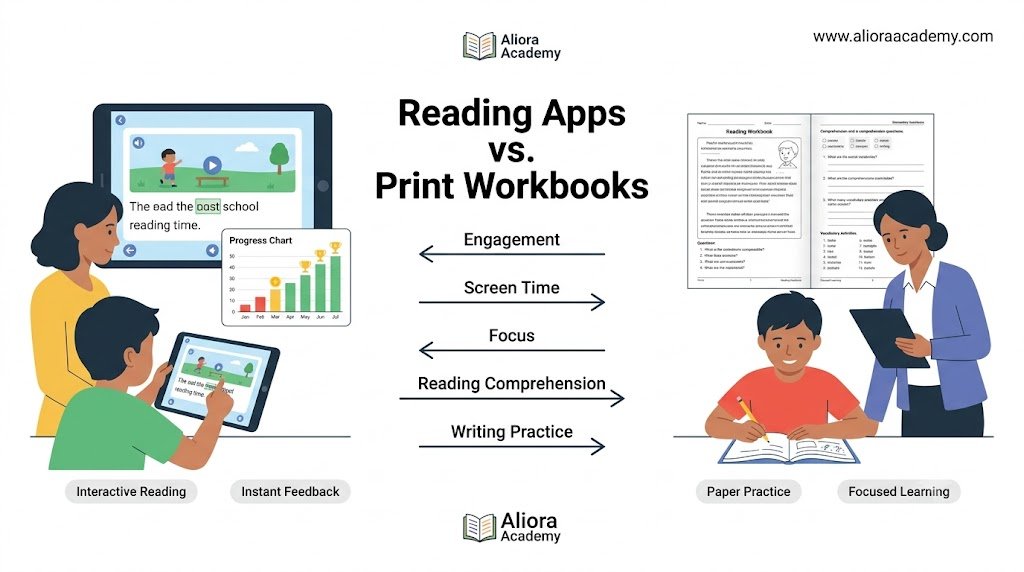
Many families find that the best approach combines the strengths of both digital and print reading tools.
Walk into any elementary classroom or homeschool setting today, and you will likely see both tablets and printed workbooks side by side. Parents and teachers face a genuine dilemma: should reading instruction lean into the engaging, interactive world of apps, or stick with the proven, tactile experience of print workbooks? The debate over reading apps vs print workbooks is not about which one is inherently superior — it is about understanding what each tool does best and when to use it.
Children learn to read through a combination of skill-building, repetition, and meaningful engagement with text. Both apps and workbooks can contribute to that process, but they serve different purposes, appeal to different learning styles, and come with distinct advantages and limitations. Making an informed choice means looking beyond the marketing claims and understanding how each format supports — or sometimes hinders — reading development.
This guide breaks down everything you need to know about reading apps and print workbooks, from cognitive considerations to practical use cases. Whether you are supplementing classroom instruction, supporting a struggling reader, or building a homeschool curriculum, you will finish this article with a clear framework for deciding what works best for your child. For additional guidance on literacy resources, visit our blog where we cover a wide range of reading and learning topics.
What Are Reading Apps and How Do They Support Literacy?
Reading apps are software programs designed for tablets, smartphones, or computers that aim to develop reading skills through interactive activities. They range from phonics games and digital libraries to comprehensive reading curricula with adaptive learning paths.
Most reading apps fall into one of these categories:
- Phonics and decoding apps — Focus on letter-sound relationships, blending, and word-building through interactive exercises.
- Digital library apps — Provide access to hundreds or thousands of books, often with read-along audio and highlighting features.
- Comprehension apps — Use quizzes, animations, and gamified questions to check understanding after reading passages.
- Fluency apps — Record children reading aloud and provide feedback on pace, accuracy, and expression.
- All-in-one literacy platforms — Combine multiple skill areas into a single adaptive program that adjusts difficulty based on performance.
Many children are naturally drawn to screens, and a well-designed reading app can channel that interest into productive practice. The immediate feedback, colorful animations, and reward systems built into apps can motivate children who might otherwise resist reading activities. However, not all apps are created equal, and the quality of instruction varies dramatically from one product to another.
What Makes Print Workbooks Effective for Reading Instruction?
Print workbooks have been a cornerstone of reading instruction for generations, and for good reason. A high-quality reading workbook provides structured, sequential practice that builds skills systematically. Unlike apps, workbooks require no screen time, no internet connection, and no battery charge — they are ready whenever a child is ready to learn.
Print workbooks offer several unique advantages:
- Physical writing reinforces memory — The act of forming letters and writing words by hand engages motor pathways in the brain that strengthen letter recognition and spelling retention.
- No distractions — A workbook page presents a focused task without notifications, pop-ups, or the temptation to switch to another app.
- Tangible progress — Children can see how many pages they have completed, which builds a concrete sense of accomplishment.
- Easy to review — Parents and teachers can flip back through completed pages to identify patterns of errors and track growth over time.
- Zero screen fatigue — For children who already spend significant time on devices for school or entertainment, workbooks offer a screen-free learning alternative.
If you are looking for structured, skill-focused practice materials, our reading resources collection includes carefully selected workbooks that target phonics, fluency, vocabulary, and comprehension. For a detailed look at top-rated options, see our guide to the best reading comprehension workbooks for elementary students.
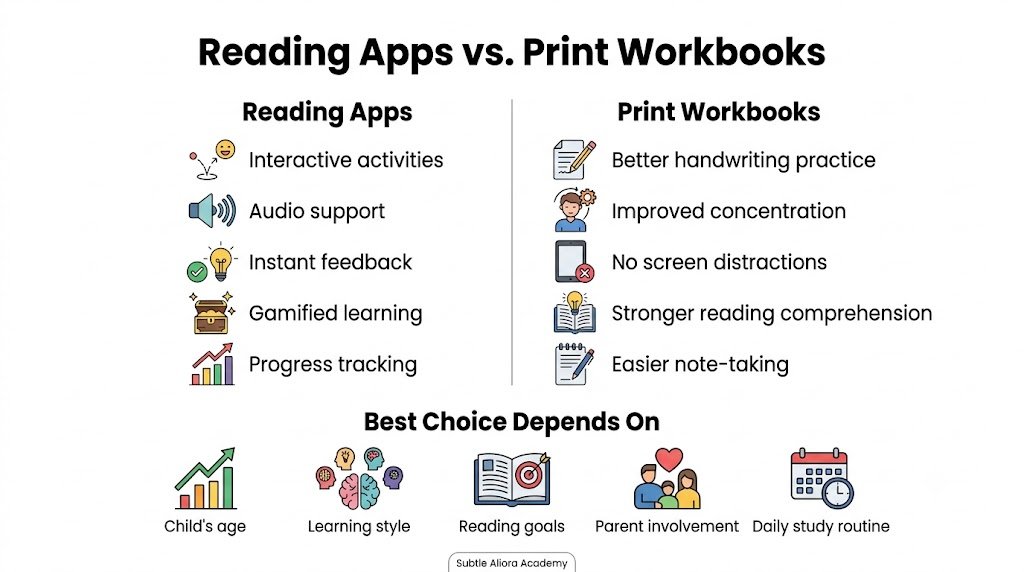
The focused, distraction-free nature of print workbooks helps many children sustain attention during reading practice.
Reading Apps vs Print Workbooks: A Side-by-Side Comparison
To make an informed decision between reading apps vs print workbooks, it helps to see how they compare across the factors that matter most for learning. The table below highlights key differences to consider based on your child's needs and your family's circumstances.
| Factor | Reading Apps | Print Workbooks |
|---|---|---|
| Engagement | High — animations, sounds, rewards, and gamification capture attention quickly. | Moderate — relies on intrinsic motivation and adult encouragement rather than built-in rewards. |
| Skill Reinforcement | Adaptive algorithms can provide extra practice in weak areas automatically. | Requires parent or teacher to identify gaps and assign targeted pages. |
| Handwriting Integration | Limited — tracing on a screen does not engage fine motor skills the same way pencil-on-paper does. | Strong — physical writing supports letter formation, spelling memory, and overall literacy development. |
| Distraction Risk | High — notifications, app-switching, and overstimulating animations can pull focus away from learning. | Low — a static page keeps attention on the task without digital interruptions. |
| Progress Tracking | Built-in dashboards show detailed analytics, time spent, and accuracy rates automatically. | Manual — parents and teachers review completed pages and note error patterns themselves. |
| Screen Time Impact | Adds to daily screen exposure, which may contribute to eye strain and sleep disruption if used close to bedtime. | None — a fully screen-free option that provides a break from digital devices. |
| Portability | Excellent — a single device can hold dozens of books and activities, ideal for travel. | Moderate — multiple workbooks can be heavy to carry but require no power source. |
| Cost Over Time | Subscription-based apps can become expensive over months and years of use. | One-time purchase per workbook; can be reused with multiple children in some cases. |
| Adult Involvement | Can be used independently by the child, though guidance improves outcomes significantly. | Benefits greatly from adult interaction, discussion, and review of completed work. |
When Do Reading Apps Work Best for Children?
Reading apps shine in specific situations where their interactive and adaptive features provide clear advantages over print materials. Understanding these scenarios helps you deploy apps strategically rather than defaulting to them for everything.
Building Phonics Automaticity Through Repetition
Phonics mastery requires hundreds of repetitions with individual sound-letter patterns. A well-designed app can make this repetition feel like a game, providing the volume of practice needed without the fatigue that can come from completing worksheet after worksheet. The immediate feedback — a chime for correct answers, a gentle prompt for incorrect ones — keeps the child engaged through dozens of trials.
Supporting Auditory Learners
Many reading apps include high-quality audio that pronounces sounds, reads words aloud, and models fluent reading. For children who learn best through listening, this audio support can bridge the gap between decoding and comprehension. Hearing a word pronounced correctly while seeing it on screen reinforces the connection between letters and sounds in ways a printed page cannot replicate on its own.
Travel and On-the-Go Learning
A tablet loaded with reading apps can replace a bag full of books and workbooks during travel. Waiting at a sibling's practice, sitting in a waiting room, or passing time on a long drive becomes an opportunity for reading practice without the need to pack physical materials.
When Are Print Workbooks the Better Choice?
Print workbooks hold their ground — and often pull ahead — in several important scenarios. Knowing when to reach for a workbook instead of opening an app can make a meaningful difference in your child's reading progress.
Developing Handwriting and Letter Formation
The physical act of writing letters by hand creates motor memories that reinforce reading skills. Research in educational psychology consistently shows that handwriting engages brain regions associated with literacy in ways that typing or screen-tracing does not. For early readers still cementing letter recognition and formation, pencil-on-paper practice is irreplaceable. Workbooks that integrate writing with reading — such as those that ask children to write a word after reading it — provide a powerful dual benefit.
Reducing Screen Fatigue
Many children already spend hours on screens for school, entertainment, and communication. Adding reading practice to that total can contribute to digital fatigue, eye strain, and difficulty winding down. Print workbooks offer a calming, screen-free alternative that can be used in the evening without affecting sleep patterns. They also give children a break from the rapid visual stimulation that apps often rely on.
Deep, Focused Comprehension Work
Reading comprehension requires sustained attention to a text. The notification-free, distraction-free nature of a printed page supports the kind of deep reading that leads to genuine understanding. When a child needs to read a passage carefully and answer thoughtful questions — especially for skills like making inferences or analyzing character motivation — a workbook page often supports deeper thinking than a screen-based equivalent. To learn more about building this critical skill, explore our article on improving 3rd grade reading comprehension.
Building Fluency Through Repeated Reading
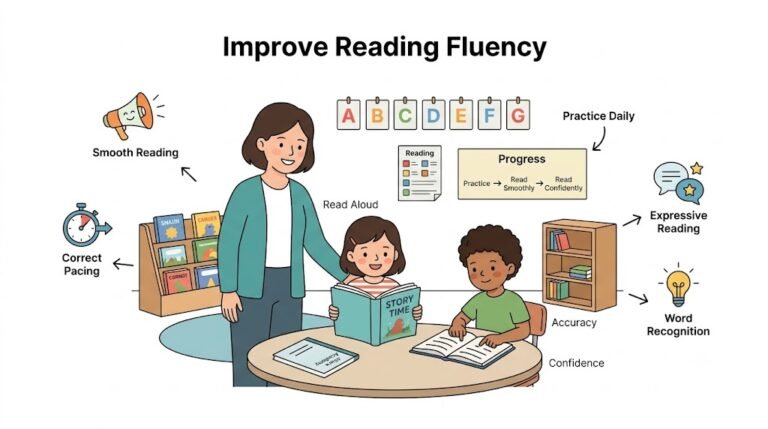
Fluency practice — reading a passage multiple times until it sounds smooth and natural — works beautifully with printed text. A child can mark up the page, underline tricky words, and track their progress with a physical timer. The simplicity of a printed passage removes the bells and whistles and keeps the focus squarely on the reading itself. For more strategies, see our guide on how to improve reading fluency.
The shared experience of working through a print workbook together creates natural opportunities for conversation and connection.
Can You Combine Reading Apps and Print Workbooks Effectively?
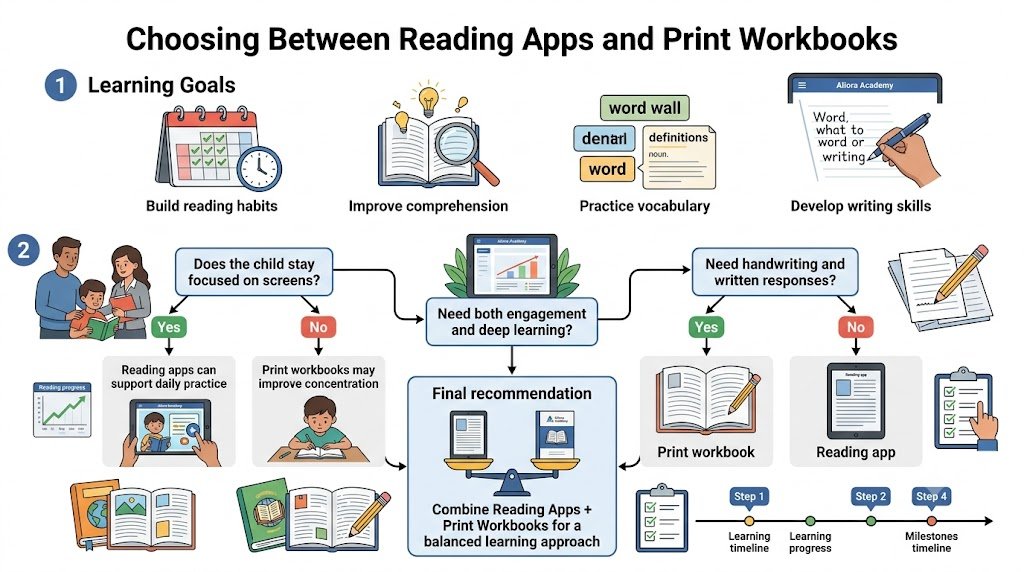
The question of reading apps vs print workbooks often frames the decision as an either-or choice, but many experienced educators and parents find that a blended approach yields the strongest results. Each format compensates for the other's weaknesses while amplifying its strengths.
A Sample Blended Learning Routine
Here is what a balanced week of reading practice might look like using both tools intentionally:
- Monday — Phonics App (15 minutes): Use a structured phonics app to practice the week's target sound pattern with interactive games and immediate feedback.
- Tuesday — Print Workbook (20 minutes): Complete workbook pages that reinforce the same phonics pattern through writing, word sorting, and reading words in isolation.
- Wednesday — Fluency App (10 minutes): Use an app that records and plays back the child's oral reading, helping them hear their own pace and expression.
- Thursday — Print Comprehension (25 minutes): Read a passage in a workbook and answer written questions that require deeper thinking and written responses.
- Friday — Digital Library (20 minutes): Browse a digital library app for free-choice reading, with the option to listen to audio support for more challenging books.
This kind of rotation keeps reading practice fresh, addresses multiple skill areas, and prevents over-reliance on any single format. It also mirrors the variety children encounter in real-world reading, where they move between screens and printed pages throughout their day. Browse our homepage to find both digital-friendly and print-based resources suited for a blended approach.
What Should You Consider Before Choosing Between Apps and Workbooks?
Every child is different, and the right mix of tools depends on factors that go beyond the features of any single product. Before investing time and money, consider these questions:
- What is your child's primary learning style? Auditory learners may benefit more from apps with read-aloud features, while kinesthetic learners often respond better to the physical act of writing in a workbook.
- How much screen time is your child already getting? If your child already spends significant time on devices for schoolwork or entertainment, adding reading apps may push screen time into unhealthy territory. A workbook provides a needed break.
- What specific reading skill needs the most attention? Phonics and fluency lend themselves well to app-based practice, while comprehension and writing-in-response questions are often better served by print materials.
- How much adult involvement is realistic in your situation? Apps can provide more independent practice, which is helpful for busy families. Workbooks benefit more from adult review and discussion.
- What is your budget over the long term? A quality workbook is a one-time purchase, while many reading apps operate on monthly or annual subscription models that add up over years of use.
- Does your child have any attention or sensory sensitivities? Children with attention challenges may find apps overstimulating and workbooks grounding. Others may find apps more engaging precisely because of the interactive elements.
Real-Life Examples of Choosing Between Reading Apps and Print Workbooks
Example 1: The Reluctant Early Reader
Situation: Ethan, age 6, resists reading practice at home. He says books are boring and would rather play on his tablet. His kindergarten teacher notes he is behind on letter-sound recognition.
Challenge: Ethan has developed a negative association with reading activities and gravitates toward screens for entertainment. Traditional workbook pages trigger immediate resistance.
Solution: His parents introduced a high-quality phonics app that used game-like levels to teach letter sounds. Because the app met Ethan where he was comfortable — on a screen — he engaged willingly. After three weeks of consistent app use, his parents gradually introduced short print workbook pages that reinforced the same phonics patterns. By then, Ethan had built enough confidence to attempt them without resistance.
Learning Outcome: Ethan's letter-sound knowledge improved steadily. The app served as an entry point that rebuilt his willingness to practice, and the workbook pages deepened the learning through writing.
Takeaway: For reluctant readers who are drawn to screens, a quality reading app can serve as a bridge back to engagement with text — especially when paired with gradual introduction of print materials.
Example 2: The Easily Distracted Third Grader
Situation: Maya, age 8, struggles with reading comprehension. Her teacher reports that she rushes through reading passages and guesses at answers. At home, Maya uses a popular reading app, but her parents notice she taps through screens quickly without absorbing the content.
Challenge: The app's fast pace and interactive elements are encouraging Maya to prioritize speed over understanding. She has learned to game the system — tapping until she gets the right answer — rather than slowing down to comprehend.
Solution: Maya's parents replaced app-based comprehension practice with a print workbook that required written responses. Without the ability to tap and guess, Maya had to slow down and think. Her parents sat with her for the first few sessions, modeling how to reread a passage when unsure of an answer.
Learning Outcome: Over two months, Maya's comprehension scores improved. She developed the habit of looking back at the text to find evidence for her answers — a skill the app's quick-tap format had not encouraged.
Takeaway: When an app's interactive format encourages speed over depth, switching to print can reset expectations and build more thoughtful reading habits. The best reading comprehension workbooks are designed specifically to promote this kind of careful, evidence-based thinking.
Example 3: The Homeschool Family Seeking Balance
Situation: The Nguyen family homeschools their three children, ages 5, 7, and 10. They want to incorporate reading practice that works across different ages and skill levels without requiring constant one-on-one instruction for every session.
Challenge: With three children at different reading levels, it is difficult to provide individualized instruction for every practice session. The parents need tools that allow some independent work without sacrificing quality.
Solution: The family adopted a blended model. Each child uses a reading app for 15 minutes of independent phonics or fluency practice while a parent works one-on-one with a sibling. Later in the day, all three children complete pages in their individual print workbooks during a quiet, screen-free block. The apps provide adaptive, independent practice, while the workbooks allow for parent review and discussion during and after completion.
Learning Outcome: The family found a sustainable rhythm. The children received both independent digital practice and the focused, relational learning that comes from working through print materials with a parent nearby.
Takeaway: For families managing multiple learners, a combination of apps and workbooks can create a practical, sustainable structure where independent and guided practice coexist.
Common Mistakes to Avoid in the Reading Apps vs Print Workbooks Decision
Frequently Asked Questions About Reading Apps vs Print Workbooks
Do reading apps actually improve reading skills?
Yes, well-designed reading apps can improve specific skills — particularly phonics, decoding, and fluency — when used consistently and paired with adult guidance. The key is choosing apps built on sound instructional principles rather than those that prioritize entertainment over learning. However, apps alone rarely address all aspects of reading, and they work best as part of a broader literacy approach.
Are print workbooks outdated for today's children?
Not at all. Print workbooks remain highly effective, especially for developing handwriting, focused comprehension, and the kind of sustained attention that screens often disrupt. Many children learn better when they can physically interact with the page — writing, underlining, and flipping back to review. Workbooks are not outdated; they are a different tool with different strengths.
How much screen time is reasonable for reading practice?
There is no universal number, but many pediatric and educational organizations recommend balancing screen-based learning with offline activities. For reading specifically, 15 to 20 minutes of high-quality app practice per day is reasonable for most elementary-aged children, especially when balanced with non-screen reading time. Pay attention to your child's overall daily screen exposure from all sources when making this decision.
Can a child learn to read using only apps?
While some children pick up reading skills through app-based practice, most literacy experts agree that apps alone are insufficient for comprehensive reading instruction. Reading involves conversation, questioning, emotional connection to stories, and real-world application — elements that require human interaction. Apps can teach skills, but they cannot replace the relational dimension of learning to read with a caring adult.
Which is better for a child with dyslexia or reading difficulties?
Children with dyslexia often benefit from structured, multisensory approaches such as Orton-Gillingham-based instruction. Some apps incorporate these principles effectively, but print materials that allow for tactile engagement — tracing letters in sand, building words with letter tiles, writing on paper — are often essential components of effective intervention. A combination is frequently recommended. For more guidance, explore our article on how to help a child struggling with reading.
How do I evaluate whether a reading app is high quality?
Look for apps that provide systematic, sequential instruction rather than random activities. Check whether the app adapts to your child's performance, offers clear feedback, and minimizes distracting animations. Read reviews from educators rather than relying solely on app store ratings. A quality app should feel like structured practice, not just an entertaining game with occasional reading elements.
Are there situations where I should avoid reading apps entirely?
If your child already has high daily screen time, shows signs of digital fatigue, becomes dysregulated after screen use, or has attention challenges exacerbated by interactive media, print workbooks may be the wiser primary choice. Similarly, for evening reading practice close to bedtime, printed materials avoid the blue light exposure that can interfere with sleep.
What is the most cost-effective approach?
Print workbooks typically offer better long-term value since they involve a one-time purchase. Reading apps with monthly or annual subscriptions can become significantly more expensive over multiple years. A cost-effective strategy is to invest in quality workbooks for core skill practice and use free or low-cost apps as supplements. Visit our homepage to explore affordable, high-quality options across both categories.
Making the Right Choice for Your Young Reader
The question of reading apps vs print workbooks does not have a single right answer — and that is a good thing. It means you have the freedom to choose what works for your unique child, in your unique circumstances, at each stage of their reading journey. Some children thrive with the interactive feedback of a well-designed app. Others blossom when given a quiet corner, a sharp pencil, and a thoughtfully crafted workbook. Many benefit from both.
What matters most is not the format but the intentionality behind it. A reading app used mindfully — with time limits, curated content, and adult check-ins — can accelerate skill development and build confidence. A print workbook completed with care, discussion, and encouragement can deepen comprehension and foster a love for the written word. The two formats are not competitors; they are complementary tools in a well-rounded literacy toolkit.
As you make decisions for your child or students, stay curious and flexible. Notice what lights them up. Pay attention to what drains them. Adjust your approach as their skills grow and their needs shift. The goal is not to find the perfect product but to build a rich, varied reading life that equips children with skills for academic success and a genuine love for reading that lasts a lifetime.
For thoughtfully selected resources that support every stage of reading development, explore our reading collection. Whether you lean toward digital, print, or a blend of both, you will find materials designed with real learning outcomes in mind. If you have questions about choosing the right resources for your situation, we invite you to contact us — we are always happy to help.