Reading Comprehension Strategies Every Parent Can Use
Simple, research-backed techniques to help your child move from just reading words to truly understanding and enjoying stories and information.
Browse Reading Resources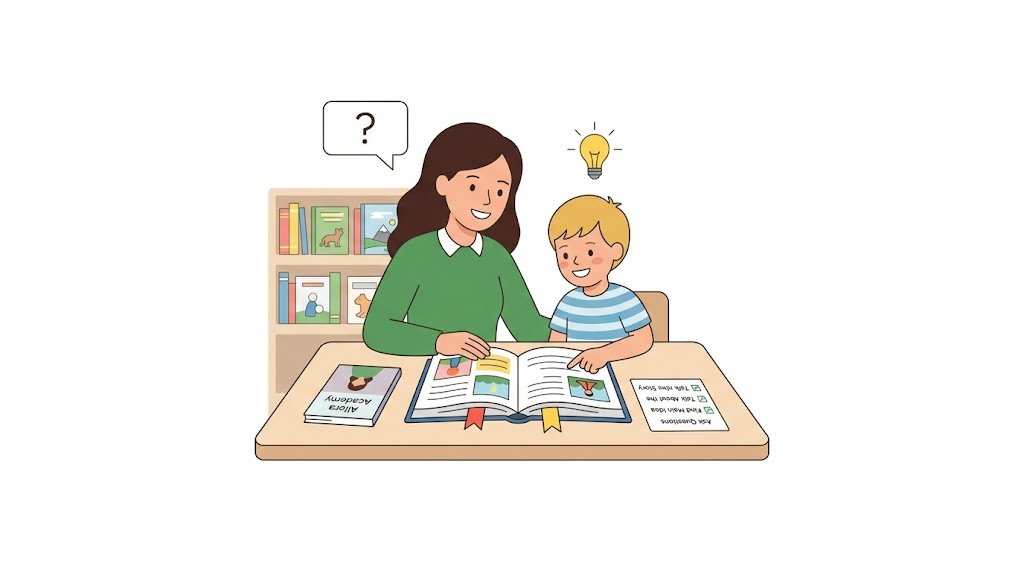
Engaging in conversation about a story is one of the most powerful ways to strengthen comprehension.
Many children can read the words on a page perfectly but still struggle to tell you what happened. They might race through a paragraph, finish a chapter, and then stare blankly when you ask a simple question about it. This is a clear sign that decoding skills and comprehension skills are not the same thing — and it's far more common than most parents realize.
Comprehension is the whole point of reading. It's the ability to understand, interpret, and think critically about what was just read. When that's missing, reading becomes a hollow exercise. The good news is that reading comprehension strategies for parents don't require a teaching degree. A few simple shifts in how you talk about books, ask questions, and choose reading material can make a significant difference. You can also find guidance and resource recommendations across our blog to support your child's literacy journey.
What Is Reading Comprehension and Why Does It Matter?
Reading comprehension is the process of constructing meaning from text. It involves not just recognizing words but connecting them to background knowledge, making inferences, and monitoring whether the text makes sense. For an elementary-aged child, this skill directly impacts success in every subject — from math word problems to science instructions to simply enjoying a bedtime story.
Without solid comprehension, children may lose motivation to read. They might call books "boring" not because the content is dull, but because they aren't connecting with it on a meaningful level. When parents understand how to nurture this skill, they help their child build a foundation for lifelong learning.
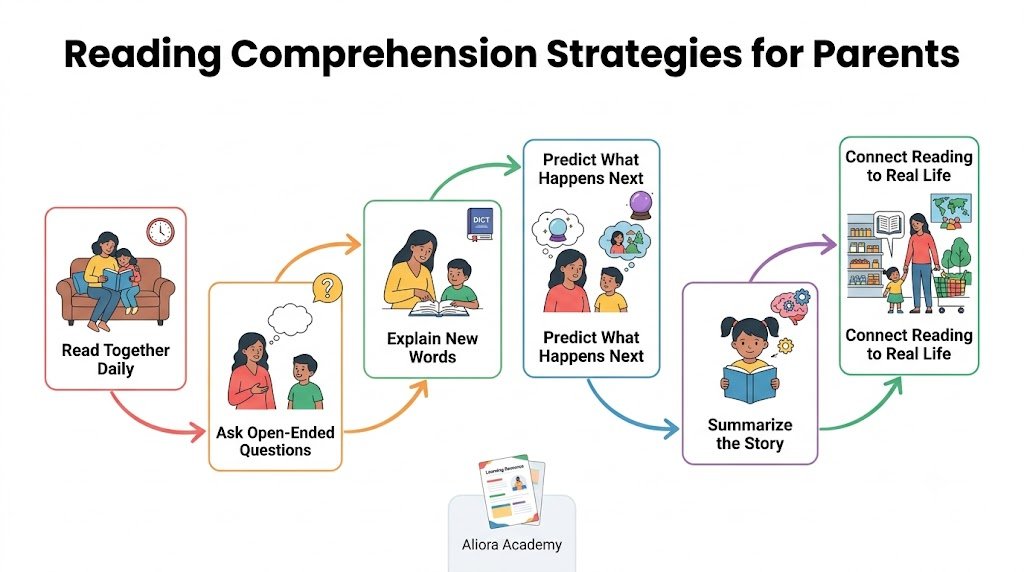
Active thinking while reading — asking silent questions, making predictions — is a habit that can be taught and practiced.
What Are the Signs That a Child Struggles with Reading Comprehension?
Sometimes the signs are subtle because the child reads aloud smoothly. Watch for these indicators that comprehension may need attention:
- Reads a passage correctly but cannot retell it in their own words.
- Has difficulty answering open-ended questions about a story (beyond simple "who" or "where" facts).
- Avoids talking about what they read; responses are minimal or vague.
- Cannot make predictions or connect the story to their own experiences.
- Struggles to explain why a character acted a certain way.
- Rarely notices when a sentence doesn't make sense — missing self-monitoring.
If several of these sound familiar, your child likely needs more explicit support with comprehension strategies. The sections ahead will give you practical tools. You may also find value in our detailed look at how to help a child struggling with reading, which addresses the full spectrum of reading difficulties.
Pre-Reading Strategies: Setting the Stage for Better Understanding
Comprehension actually begins before your child reads the first word. Pre-reading activities activate prior knowledge and give purpose to the reading, making it much easier for the brain to organize new information.
Three Pre-Reading Habits to Build
- Picture Walk — Flip through the book looking only at the pictures. Ask your child to guess what the story might be about. This builds anticipation and creates a mental framework.
- K-W-L Chart — On a sheet of paper, jot down what your child already Knows about the topic, what they Wonder, and after reading, what they Learned. This works beautifully for nonfiction.
- Set a Purpose — Instead of just saying "read this," give a simple mission: "Read to find out why the main character is worried." A purpose focuses attention.
These routines take only a few minutes but dramatically increase engagement and recall. They also show your child that reading is an active, thinking process — not passive word-calling.
During-Reading Strategies That Make a Real Difference
While reading, your child needs to practice thinking about the text. These are called "during-reading" strategies, and they are the heart of comprehension instruction.
Model Thinking Aloud
One of the most powerful things you can do is read a passage and verbalize your own thoughts: "I'm wondering why she did that… Oh, I see now, she felt left out. That reminds me of a time I felt left out." This shows your child that good readers are constantly questioning, predicting, and connecting as they read.
Teach Visualization
Encourage your child to create a "movie in their mind" while reading. Stop after a descriptive paragraph and ask, "What do you see? What does the place look like? What sounds do you hear?" Visualization deepens understanding and makes reading more enjoyable. Our article on building reading confidence in kids explores how these small successes accumulate into a positive reading identity.
Ask Open-Ended Questions
Move beyond yes/no questions. Try prompts like:
- What do you think will happen next and why?
- How do you think the character is feeling right now?
- What would you do if you were in this situation?
- Does anything in this story remind you of your own life?
These questions require your child to think beyond the surface level. Don't worry about right or wrong answers — the goal is conversation and reasoning.
Clarify When Meaning Breaks Down
Teach your child to notice when a sentence doesn't make sense. A simple strategy is "Stop, Reread, and Think." If a word is causing trouble, try to figure it out from context or look it up together. This self-monitoring habit is a hallmark of strong readers.
After-Reading Activities That Make Understanding Stick
The learning continues after the book is closed. After-reading activities help consolidate understanding and reveal any lingering confusion.
Retelling in Their Own Words
Ask your child to tell you what happened in the story, in order. Use prompts like "First… then… next… finally…" This builds sequencing skills and reveals whether they grasped the main events. For a deeper dive into grade-level expectations, our guide to improve 3rd grade reading comprehension offers specific benchmarks and activities.
Draw a Scene or Make a Story Map
Not every child responds well to verbal-only activities. Drawing a favorite scene, creating a comic strip of the plot, or mapping out the story elements (characters, setting, problem, solution) uses visual-spatial strengths to reinforce understanding.
Connect to Life
The deepest comprehension happens when a child relates the text to their own world. "Has anything like this ever happened to you?" "What did you learn that you didn't know before?" These connections anchor the reading in personal meaning.
Choosing the Right Books and Resources to Strengthen Comprehension
Not all reading materials are equal when your goal is to improve comprehension. The book's structure, interest level, and support features all matter.
| Look For | Avoid |
|---|---|
| Stories with clear plot structures and relatable characters | Books that are so challenging your child spends all mental energy on decoding |
| Nonfiction with headings, photos, and captions that support meaning | Dense blocks of text without visual breaks |
| Comprehension workbooks that teach strategies explicitly (predict, infer, summarize) | Worksheets that only ask recall questions |
| Books at the child's independent or instructional reading level | Books far above the child's current level that cause frustration |
| Materials that include discussion prompts for parents | Resources with no built-in guidance for the adult helper |
If you're looking for ready-to-use comprehension practice, we recommend exploring our list of the best reading comprehension workbooks for elementary students. Workbooks designed with explicit strategy instruction can be game-changers. For a discussion of digital versus print, our comparison of reading apps vs workbooks helps you decide what fits your family best.
You can browse our full collection of reading resources for materials that target comprehension at every grade level.

A mix of engaging storybooks and targeted practice materials provides the perfect balance for growth.
Common Mistakes to Avoid When Building Comprehension Skills
Even well-intentioned efforts can backfire if they create pressure or focus on the wrong things. Here are pitfalls to watch for:
Real-Life Examples of Comprehension Strategies in Action
Example 1: The “But I Read It!” Phenomenon
Situation: Arjun, age 8, reads a short chapter book quickly but shrugs when asked what it was about. He says, "I don't know, I just read the words."
Challenge: Arjun has developed the habit of reading for completion rather than understanding. He sees reading as a task to finish.
Solution: His mother introduced sticky notes. Before reading, they agreed he would place a note on any page where something interesting happened — a funny moment, a surprise, a new fact. After reading, they looked at each note and talked. She also modeled thinking aloud with her own book.
Learning Outcome: Within a few weeks, Arjun started naturally pausing to share thoughts while reading. His retellings became longer and more organized.
Takeaway: Giving a tangible, low-pressure way to mark thinking transformed reading from a race to a conversation.
Example 2: The Word-Caller
Situation: Chloe, age 10, reads beautifully aloud but struggles with written comprehension questions. Her teacher notes that she doesn't seem to monitor whether a sentence makes sense.
Challenge: Chloe is so focused on pronunciation that she neglects meaning. She lacks the self-checking habit.
Solution: Her father introduced the "Read, Cover, Remember, Check" routine. She reads a paragraph, covers it, says what she remembers, then uncovers to verify. They also practiced with sentences containing obvious nonsense (e.g., "The dog flew a bicycle to school") to train her to notice when something was off.
Learning Outcome: Chloe's self-monitoring improved significantly. She began to stop and reread independently, and her comprehension scores rose.
Takeaway: Explicit practice in noticing breakdowns gave Chloe the missing skill of active self-checking.
Example 3: Reluctant Nonfiction Reader
Situation: Marcus, age 9, only wants to read informational books but retains very little. He skims, looks at pictures, and moves on.
Challenge: Marcus is curious but lacks the stamina and strategies to extract information from text.
Solution: His parents used a K-W-L chart with a book about sharks. Before reading, Marcus listed what he knew (which was a lot) and what he wondered. During reading, he stopped after each section to add a note. Afterward, the "Learned" column was full of details. The chart gave purpose and structure to his curiosity.
Learning Outcome: Marcus now independently uses a notebook to jot down facts and questions from nonfiction. His comprehension of informational text deepened significantly.
Takeaway: Pairing an existing passion with a simple graphic organizer turned scattered skimming into focused learning.
Frequently Asked Questions About Reading Comprehension
At what age should I start teaching comprehension strategies?
Comprehension talk can start as soon as you read to your toddler. Asking "What do you think will happen next?" or "How does the bear feel?" builds foundational thinking habits. Explicit strategies like summarizing and visualizing work well from around first grade onward, but the earlier you model thinking aloud, the better.
How can I tell if a comprehension workbook is high-quality?
Look for workbooks that teach strategies explicitly — they should name the skill (e.g., "Making Inferences") and provide a short explanation, not just questions. Passages should be engaging and age-appropriate. Check that the questions include a mix of literal, inferential, and critical thinking types. Our list of the best reading comprehension workbooks for elementary students can point you in the right direction.
My child hates talking about books. What can I do?
Swap verbal discussion for a different medium. Ask them to draw a scene, act out a favorite part with toys, or build something from the story with blocks. Sometimes the richest comprehension comes out when there's no pressure to "perform" a spoken answer. Gradually introduce casual conversation once the association with books becomes more positive.
Does listening to audiobooks help with comprehension?
Yes, especially for children who struggle with decoding. Audiobooks remove the barrier of word-reading so the child can focus entirely on meaning, vocabulary, and story structure. Pairing an audiobook with the printed text (immersion reading) can also support comprehension and fluency simultaneously.
How is comprehension different from reading fluency?
Fluency is the ability to read accurately, at a good pace, and with expression. A child can be fluent but still not comprehend. However, fluency does support comprehension because it frees up mental energy for meaning. If your child reads haltingly, working on fluency is also important. Read our article on how to improve reading fluency for actionable tips.
Should I correct my child's comprehension mistakes immediately?
Not always. If the mistake changes the meaning, you can gently say, "Hmm, that part might mean something else. Let's reread together." If it's a minor detail, let it go. Constant correction can discourage risk-taking. Save deeper discussions for after a natural stopping point.
Can I use the same strategies for fiction and nonfiction?
Yes, but they are applied differently. Predicting looks different in a story (what will the character do next?) versus nonfiction (what information might come next?). Summarizing fiction focuses on plot, characters, and conflict, while summarizing nonfiction captures main ideas and key details. Modeling both explicitly helps children become flexible readers.
What if I'm not a strong reader myself? Can I still help my child?
Absolutely. Your conversation, curiosity, and encouragement are far more powerful than perfect reading ability. You can ask questions, listen to your child read, look at pictures together, and share what you notice. Your positive presence and genuine interest are the most important ingredients. For additional support, our homepage and contact page are always here to help.
Helping Your Child Grow into a Thoughtful, Engaged Reader
Reading comprehension is not a switch that flips on. It grows slowly, through many small conversations, many sticky-note thoughts, and many bedtime stories where you pause and wonder together. Every time you ask your child what they think, you are not just checking understanding — you are teaching them that their thoughts matter and that reading is an act of discovery, not just decoding.
The strategies in this guide are designed to fit naturally into your family's rhythm. You don't need to use all of them at once. Start with one pre-reading habit and one during-reading technique that feel comfortable. Notice your child's response and build from there. And remember, comprehension grows best in a low-pressure environment where books are a source of connection, not correction.
The journey of a thousand stories begins with a single conversation about a single page. You have all the tools you need to walk that journey alongside your child. For more support, explore our blog for further literacy guidance, or reach out if you need personalized recommendations. Every step forward, no matter how small, is a victory worth celebrating.