Reading Intervention Activities for Small Groups
Targeted, research-backed activities that help struggling readers build essential skills in a supportive, collaborative small group setting.
Explore Reading Resources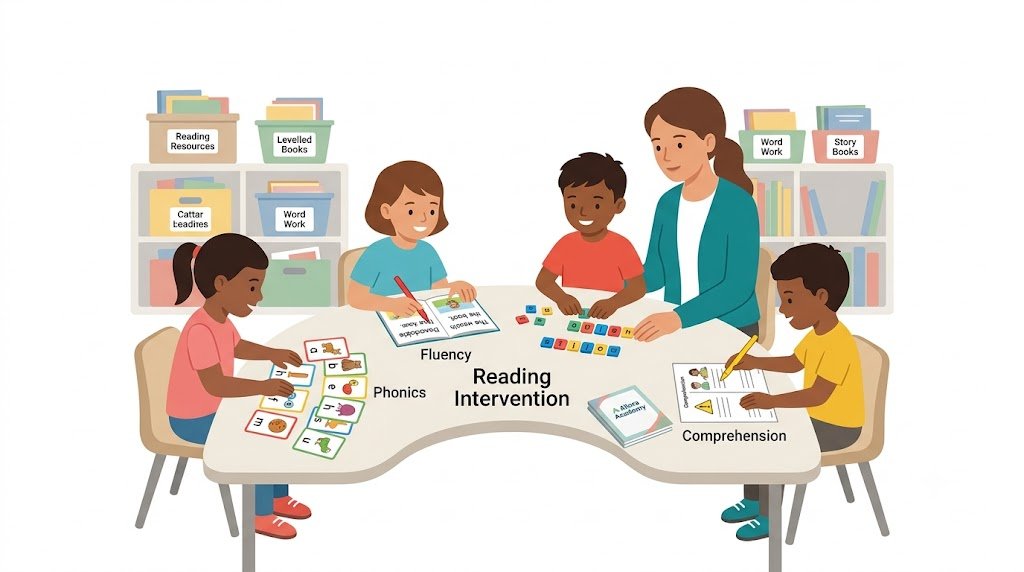
A focused small group setting allows for individualized attention and meaningful peer interaction during reading intervention.
When a child falls behind in reading, whole-class instruction alone is rarely enough to close the gap. That's where reading intervention small group activities become essential. By working with three to five students at a time, educators can provide the targeted, responsive instruction that struggling readers need most — while also creating a safe space where children feel comfortable taking risks, making mistakes, and building confidence alongside peers who share similar challenges.
Small group intervention isn't simply about reducing the student-to-teacher ratio. It's about designing intentional, skill-focused activities that address specific gaps in phonemic awareness, phonics, fluency, vocabulary, and comprehension. When structured well, these sessions become the most powerful block of the instructional day — for both the students and the educator leading them.
This guide explores why small group intervention works, how to group students effectively, which activities deliver the strongest results, and what resources can support your efforts. Whether you're a classroom teacher, a reading specialist, a tutor, or a homeschool parent coordinating a learning pod, you'll find practical strategies you can implement right away. For a broader look at supporting young readers, visit our educational blog, where we cover everything from early literacy to advanced comprehension.
Why Are Small Group Reading Interventions So Effective?
There is a reason small group instruction has remained a cornerstone of effective reading intervention for decades. When done well, it offers a combination of benefits that whole-class instruction simply cannot replicate.
Small group intervention works because it provides:
- Targeted instruction — Every activity can be matched to the specific skill gaps of the students in the group, rather than a generic grade-level expectation.
- More opportunities to respond — In a group of four, each child gets far more practice turns than in a class of twenty-five. Active engagement drives learning.
- Immediate corrective feedback — The teacher can catch and correct errors in the moment, preventing students from practicing mistakes.
- A lower-anxiety environment — Struggling readers often feel exposed in a full class. A small group of peers at similar levels reduces that fear significantly.
- Peer learning and modeling — Children learn from watching each other work through challenging words and passages.
- Stronger teacher-student relationships — Small groups allow educators to know each child's strengths, triggers, and learning style intimately.

Hands-on manipulatives and multisensory techniques are especially effective during small group phonics intervention.
How Do You Group Students Effectively for Reading Intervention?
Thoughtful grouping is the foundation of successful intervention. Groups should be fluid, data-driven, and focused on specific skill needs rather than static ability labels.
Use Diagnostic Data, Not Just Reading Levels
A single reading level tells you where a child is, but not why they're stuck there. Use phonics screeners, phonemic awareness assessments, fluency timings, and comprehension checks to pinpoint the exact skill gaps. Two children reading at the same level may need entirely different interventions — one might lack decoding skills while the other struggles with vocabulary.
Common Grouping Models for Reading Intervention
- Skill-Based Groups — Students grouped by a shared deficit, such as short vowel confusion, digraph mastery, or multisyllable decoding. These groups are highly targeted and typically short-term.
- Strategy Groups — Students grouped around a shared need for a specific comprehension or fluency strategy, such as making inferences or reading with phrasing.
- Guided Reading Groups — Students at similar instructional reading levels working with leveled texts. This model works well when students have generally balanced reading profiles.
- Mixed-Ability Pairs within Groups — Occasionally pairing a slightly stronger reader with one who needs more support can build leadership and reinforce skills for both children.
Remember that groups should change regularly based on ongoing progress monitoring. A child who masters short vowels should move to a new group focusing on the next skill. Flexibility prevents stagnation and ensures that every session is time well spent. For more on structured approaches to reading support, explore our guide on reading intervention programs that incorporate grouping best practices.
What Are the Best Phonics Activities for Small Group Intervention?
For many struggling readers, phonics gaps are the root cause of their difficulty. Small group settings are ideal for the explicit, multisensory practice that solidifies letter-sound connections.
Word Building with Magnetic Letters
Give each student a small set of magnetic letters and a magnetic board or cookie sheet. Call out a word with the target phonics pattern — for example, "chat" when working on digraphs. Students build the word, check their work against a model, and then change one letter to make a new word ("chap," "chap" to "chip"). This activity engages visual, tactile, and auditory channels simultaneously.
Sound Boxes (Elkonin Boxes)
Draw a row of boxes on a whiteboard or use a printed template — one box for each sound in a word. Students push a chip, token, or their finger into each box as they say the corresponding sound, then blend the sounds together. This activity builds the phonemic awareness foundation that underlies all decoding. For children who need intensive phonics support, our guide to the best phonics programs for struggling readers offers additional structured resources.
Word Sorts
Provide students with a set of word cards featuring contrasting patterns — for example, short "a" versus short "i" words, or "ai" versus "ay" spellings. Students read each word aloud and sort it into the correct category. Word sorts help children move beyond memorization and recognize orthographic patterns independently. They also spark productive discussions about why certain spellings are used.
Roll and Read Games
Create a grid of words following the target phonics pattern. Students roll a die, find the corresponding row or column, and read the word aloud. The game format transforms drill practice into an engaging, low-stakes activity. Students often don't realize how many repetitions they're getting because they're focused on the game.
How Can You Build Reading Fluency in a Small Group Setting?
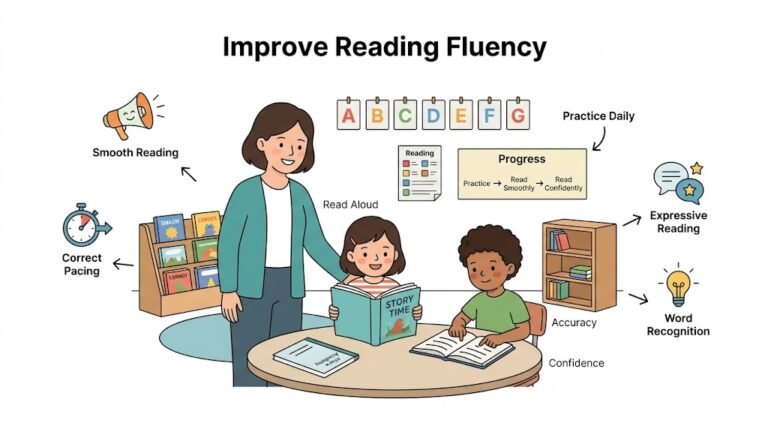
Fluency — reading with accuracy, appropriate speed, and expression — is the bridge between decoding and comprehension. Children who read laboriously expend so much mental energy on word recognition that little is left for understanding.
Choral Reading
The entire group reads a passage aloud in unison, with the teacher's voice leading and setting the pace. Choral reading provides cover for hesitant readers and models fluent pacing naturally. Choose short, rhythmic texts such as poems, song lyrics, or carefully selected passages from decodable books.
Echo Reading
The teacher reads a sentence or short phrase with appropriate expression, and the students echo it back. This technique isolates phrasing and prosody — the musical qualities of language that convey meaning. Over time, students internalize what fluent reading sounds like and begin to apply it independently.
Repeated Reading with a Partner
Pair students within the small group and give each pair a short passage at their instructional level. One partner reads while the other tracks and provides gentle feedback. Then they switch roles. After several readings, students time each other and chart their progress. The visual evidence of improvement is highly motivating. For additional fluency-building techniques, see our comprehensive article on reading fluency strategies that can be used across settings.
Reader's Theater
Assign each student a character role from a short script or adapted text. Students practice their parts, focusing on expression and phrasing, before performing for each other. Reader's theater naturally encourages rereading — and because the goal is performance rather than assessment, children engage with enthusiasm rather than anxiety.
Partner reading builds fluency while fostering collaboration and peer support within a small group.
What Comprehension Activities Work Best in Small Intervention Groups?
Comprehension is the ultimate goal of reading. In a small group, you can model thinking processes explicitly and give students the guided practice they need to internalize comprehension strategies.
Think-Aloud Modeling
Read a short passage aloud and pause frequently to verbalize your thinking: "I just read that the character slammed the door. I'm inferring she's angry because the author didn't tell me directly, but slamming a door is something people do when they're upset." Students need to hear what active, strategic reading sounds like inside a proficient reader's head. For structured guidance on teaching comprehension skills such as identifying the central point, see our article on how to teach main idea and details effectively.
Reciprocal Teaching
In this structured discussion format, students take turns leading the group through four comprehension processes: predicting, questioning, clarifying, and summarizing. The teacher initially models each role, then gradually releases responsibility. Reciprocal teaching works particularly well with informational texts and has a strong evidence base for improving comprehension in struggling readers.
Text-Dependent Questioning
Rather than asking broad questions like "What happened?" use questions that require students to return to the text for evidence. "Which word on page two tells you how the character was feeling?" "Can you find the sentence that explains why the experiment failed?" This habit of returning to the text builds close reading skills and prevents guessing.
How Should You Structure a Small Group Reading Intervention Session?
A clear, predictable routine maximizes instructional time and reduces cognitive load for students who already find reading demanding. When children know what to expect, they can focus their energy on learning rather than on figuring out the flow of the session.
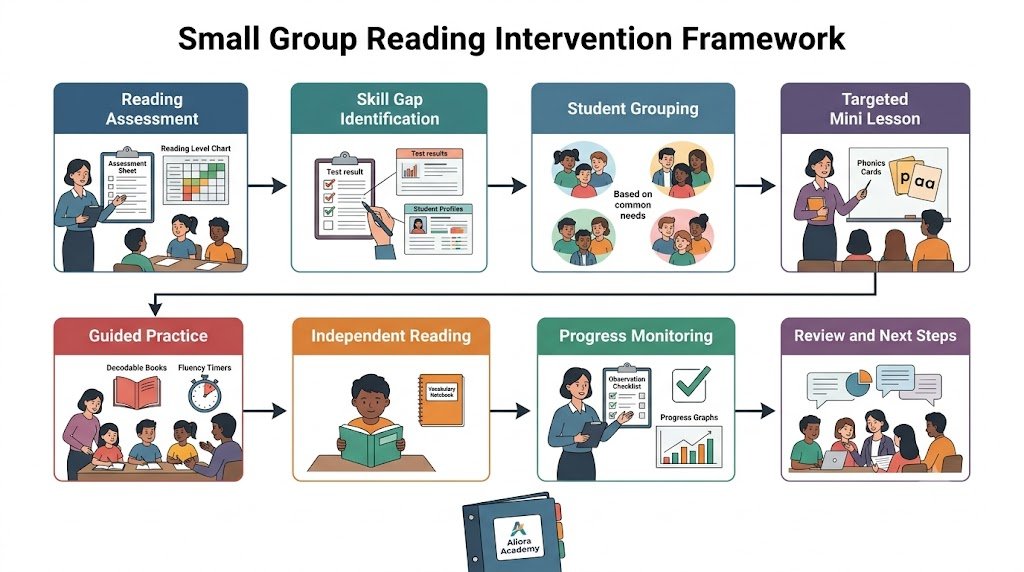
| Time | Component | What Happens |
|---|---|---|
| 0–3 min | Warm-Up | Quick phonemic awareness drill, review of previously learned sounds or sight words, or a brief fluency sprint with a familiar passage. |
| 3–12 min | Skill Focus | Explicit instruction and guided practice on the target skill — phonics pattern, fluency technique, or comprehension strategy. Teacher models, then students practice with support. |
| 12–20 min | Application | Students apply the skill to connected text — reading a decodable passage, a short story, or an informational paragraph. Teacher listens in, provides coaching, and takes anecdotal notes. |
| 20–25 min | Wrap-Up & Transfer | Brief dictation or written response to check for transfer. Teacher reviews the key point of the session and gives students a specific reminder to apply during independent reading. |
This structure is flexible. Some groups may need more time on skill work; others may benefit from a longer application block. The non-negotiables are that every session includes explicit teaching, supported practice, and a clear connection to real reading. For additional activity ideas that complement this structure, browse our guided reading activities for grade 3, many of which adapt well to intervention settings.
What Resources Best Support Small Group Reading Intervention?
The right materials can make or break a small group session. Resources should be aligned to the specific skill being taught, engaging enough to hold attention, and designed for the intensity that intervention demands.
| Resource Type | Best For | What to Look For |
|---|---|---|
| Decodable Texts | Phonics application, building decoding automaticity | High percentage of words following taught patterns, engaging storylines despite controlled vocabulary |
| Phonics Workbooks | Systematic skill practice, independent reinforcement | Clear sequence, cumulative review, uncluttered pages, appropriate for the child's age |
| Comprehension Workbooks | Strategy practice with short passages | Passages at the right instructional level, questions that require thinking beyond recall |
| High-Interest/Low-Readability Books | Older struggling readers, engagement and stamina | Mature topics written at accessible reading levels, relatable characters, appealing design |
| Word Study Manipulatives | Hands-on phonics and vocabulary work | Magnetic letters, word sorting cards, sound boards, syllable puzzles |
When selecting materials, prioritize quality over quantity. A few well-chosen resources used consistently will outperform a cluttered shelf of items that never get fully utilized. Our reading intervention resources for elementary students page features curated materials organized by skill area, making it easier to find exactly what your group needs. For comprehension-focused groups, you may also find value in our reviews of the best reading comprehension workbooks for elementary students and grade 3 comprehension workbooks specifically.
What Are Common Mistakes to Avoid in Small Group Reading Intervention?
Even experienced educators can fall into patterns that reduce the effectiveness of small group time. Awareness of these pitfalls helps you sidestep them from the start.
Real-Life Examples of Small Group Reading Intervention in Action
Example 1: Kindergarten Phonemic Awareness Group
Situation: Four kindergarten students struggle with identifying the first sound in spoken words. They cannot reliably answer questions like "What sound do you hear at the beginning of 'sun'?"
Challenge: These students need explicit, multisensory phonemic awareness instruction before they can benefit from phonics. Whole-class activities move too quickly and don't provide enough individual practice.
Solution: The teacher meets with the group for 15 minutes daily. Each session includes sound-matching games with picture cards, songs that emphasize alliteration, and simple Elkonin box activities using tokens to represent sounds. The teacher uses hand gestures to reinforce the concept of "first sound" and has each child produce the target sound aloud multiple times per session.
Learning Outcome: After four weeks, three of the four students could reliably isolate initial sounds. The fourth needed additional support, which the teacher was able to provide during an extra session each week because the small group format made it clear exactly where the breakdown was occurring.
Takeaway: Small group time allows for the intensity and repetition that foundational skills demand — and makes it easy to identify which children need even more support.
Example 2: Second Grade Decoding Group
Situation: Five second graders can read CVC words but struggle with vowel teams and silent-e patterns. They guess frequently and become frustrated with grade-level texts.
Challenge: These children have gaps in their phonics knowledge that prevent them from advancing. Whole-class phonics instruction has moved past these patterns, and the students need targeted reteaching.
Solution: The reading specialist creates a four-week intervention cycle focused on long vowel patterns. Each 25-minute session follows a consistent routine: a quick sound drill, explicit introduction of the target pattern, word building with magnetic letters, reading a short decodable passage featuring the pattern, and a quick dictation to check for transfer. The specialist uses our recommended phonics program for struggling readers as the backbone of the instruction.
Learning Outcome: By the end of the cycle, students demonstrated mastery of silent-e and the most common vowel teams. Their decoding accuracy during passage reading improved noticeably, and two students were ready to exit the intervention group.
Takeaway: Systematic, skill-focused cycles with clear entry and exit criteria ensure that intervention is both efficient and accountable.
Example 3: Fourth Grade Fluency and Comprehension Group
Situation: Three fourth graders read accurately but slowly, with flat expression. They can answer literal questions but struggle with inferential comprehension. Their slow reading rate means they fall behind on assignments that require independent reading.
Challenge: These students need to build automaticity and prosody so that cognitive resources are freed for deeper thinking. They also need explicit instruction in inference-making.
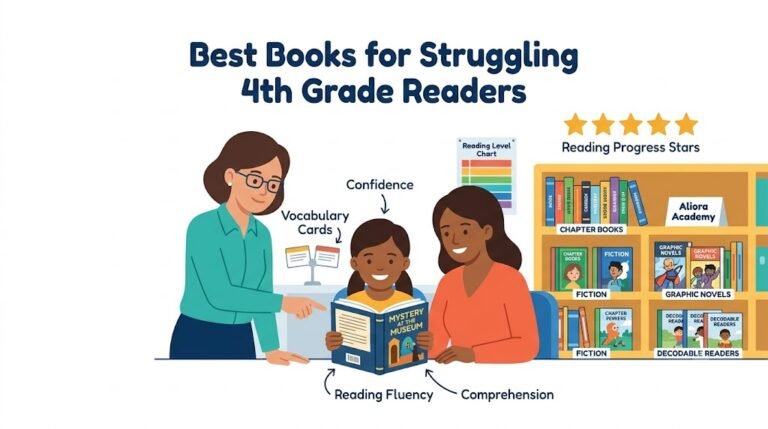
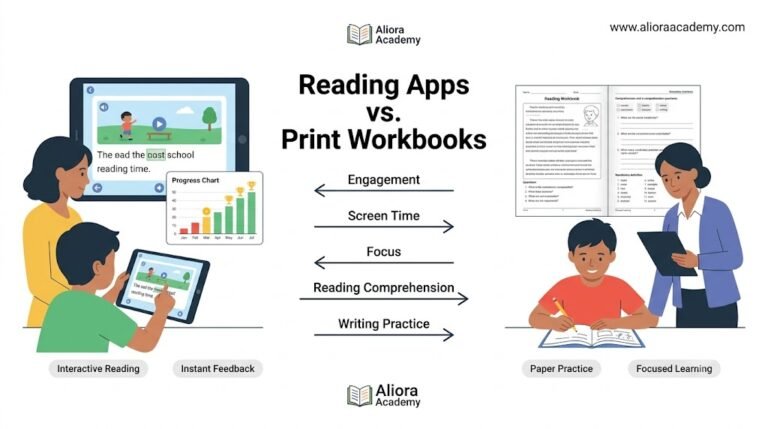
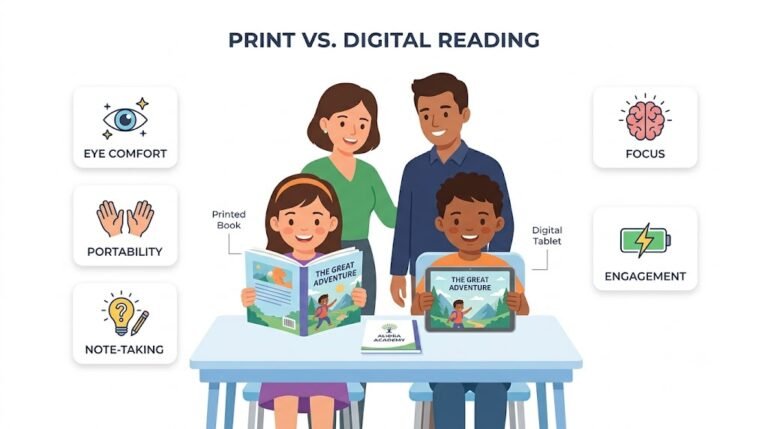
Solution: The teacher uses a combined fluency-comprehension approach. Sessions begin with repeated reading of short, high-interest passages — including excerpts from engaging chapter books suitable for struggling older readers, similar to those featured in our list of best books for struggling 4th grade readers. After building fluency with a passage, the group discusses it using the reciprocal teaching framework, with special emphasis on questioning and clarifying. The teacher also introduces audio-supported reading for independent practice, acknowledging the ongoing discussion about print versus digital reading for kids.
Learning Outcome: Over eight weeks, students' oral reading fluency scores improved by an average of 18 words correct per minute. More importantly, their ability to make and support inferences showed marked growth as measured by both classroom assessments and teacher observation.
Takeaway: For older elementary students, fluency and comprehension work can and should be integrated. Building automaticity creates the conditions for deeper thinking.
How Can Parents and Caregivers Support Small Group Intervention at Home?
The impact of small group intervention multiplies when skills are reinforced at home. Parents don't need to replicate the full session — simple, consistent activities can make a meaningful difference.
- Ask the intervention teacher for specific activities — Most educators are happy to share a short list of words, a decodable passage, or a game that aligns with what the group is working on.
- Practice the same skill, not just any reading — If the group is working on digraphs, spend home practice time on digraph words rather than randomly selected books.
- Keep home sessions brief and positive — Ten minutes of focused, encouraging practice beats a forced, frustrating thirty-minute session every time.
- Celebrate effort and growth — Notice and name the specific improvements you see. "You sounded out that long word without giving up — that's exactly what strong readers do."
For families who want to deepen their understanding of how children learn to read, our science of reading resources for parents provides accessible explanations and practical tools. When parents and educators work from a shared understanding of reading development, children benefit enormously.
Frequently Asked Questions About Small Group Reading Intervention
How many students should be in a reading intervention group?
For most intervention purposes, three to five students is ideal. This size allows for individual attention and ample practice opportunities while still benefiting from peer interaction. Groups of six or more begin to lose the advantages of small group instruction. For children with the most intensive needs, groups of two or three may be more appropriate.
How long should a small group intervention session last?
For elementary students, sessions of 20 to 30 minutes tend to work best. This is long enough to include explicit instruction, guided practice, and application to text, but short enough to maintain focus. Younger children or those with attention challenges may benefit from 15-minute sessions. Frequency matters more than duration — daily sessions yield stronger results than longer sessions held less often.
What if my small group students have very different needs?
If the skill gaps within a group are too broad, the instruction won't be targeted enough for anyone. In that case, regroup based on the most pressing shared need. It's better to have a very small group — even two students — that is well-matched than a larger group with mismatched needs. Flexible, data-driven regrouping is the hallmark of effective intervention.
Can small group intervention work in a homeschool or pod setting?
Yes. Homeschool families participating in learning pods or co-ops often find small group intervention highly manageable. The same principles apply: assess to identify skill gaps, group children with similar needs, and use structured, multisensory activities. Our reading resources collection includes materials suitable for both classroom and home-based intervention settings.
How do I know when a child is ready to exit intervention?
Exit decisions should be data-based, not calendar-based. When a child consistently demonstrates the target skill at the expected level — as measured by progress monitoring assessments — and can apply it in connected text and classroom work, they may be ready to transition out. A gradual release, where the child attends intervention less frequently before fully exiting, can help ensure the gains stick.
What if I don't have enough time in my schedule for small groups?
This is one of the most common challenges teachers face. Look for creative solutions: Can you use a station-rotation model where one station is teacher-led small group instruction while others engage in meaningful independent practice? Can an instructional aide, reading specialist, or trained volunteer lead a group? Even two or three small group sessions per week are far better than none. Prioritizing intervention time is a matter of both scheduling and philosophy.
Should intervention groups use the same texts as the rest of the class?
Generally, no. Intervention texts should be at the students' instructional level, which may differ significantly from grade-level material. Using texts that are too difficult undermines the purpose of intervention. However, you can and should occasionally build bridges to grade-level content — for example, by pre-teaching key vocabulary or doing a shared reading of a challenging passage that the rest of the class will also encounter.
How can I keep the rest of the class engaged while I'm working with a small group?
Establish clear routines and expectations for independent work time. Activities should be meaningful — not busy work — and students should know what to do if they finish early or need help. Gradual release of responsibility applies to independent work habits too. Invest time in teaching and practicing these routines at the start of the year. For activity ideas that work well during independent work time, explore our independent reading activities collection.
Making Every Small Group Session Count
Reading intervention small group activities represent one of the most powerful tools educators and parents have for closing reading gaps. When groups are thoughtfully formed, sessions are structured around clear skill targets, and activities engage students in active, multisensory practice, the results can be transformative — not just for reading scores, but for how children see themselves as readers.
The strategies and activities outlined in this guide are not quick fixes. They require consistency, patience, and a willingness to adjust based on what the data shows. But the investment is worth it. Every time a struggling reader successfully decodes an unfamiliar word, reads a passage with natural expression, or grasps the deeper meaning of a text, a brick is added to the foundation of lifelong literacy.
As you plan your next small group cycle, remember that the most important ingredient is not any specific activity or resource — it's the relationship you build with your students. When children feel safe, seen, and supported in a small group, they take the risks that learning requires. Combine that emotional safety with intentional, skill-focused instruction, and you have a recipe for real progress.
We invite you to explore our full range of reading resources, browse additional guidance on our blog, and contact us if you need help finding the right materials for your intervention groups. Whether you're working with kindergartners on phonemic awareness or fourth graders on inferential comprehension, there are resources designed to support the important work you do every day.
Every child can learn to read. Small group intervention is how we make sure that belief becomes a reality — one session, one skill, one confident reader at a time.