Paired Reading Strategies for Parents to Build Reading Skills
Simple, research-backed techniques that turn reading time into a confidence-building, skill-strengthening experience for your child — without pressure or frustration.
Browse Reading Resources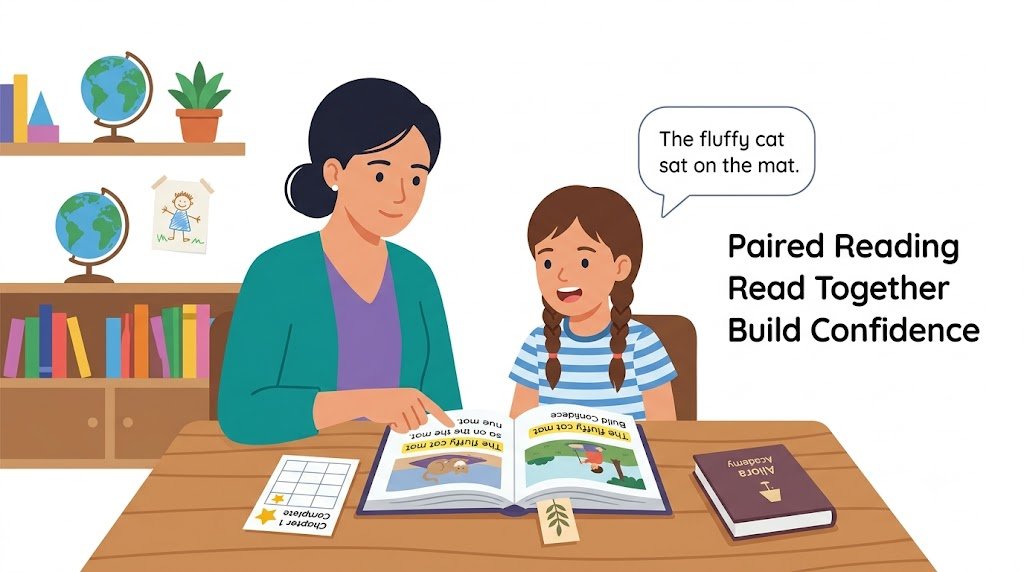
Paired reading creates a safe, shared experience where children can build fluency without the pressure of reading alone.
Reading with your child sounds simple — and in many ways, it is. But there is a difference between reading to your child and reading with your child in a way that actively builds their skills. That is where paired reading strategies for parents come in. These techniques transform everyday reading time into a powerful tool for improving fluency, comprehension, and reading confidence.
Many parents want to help their child become a stronger reader but feel unsure about the best approach. Should you correct every mistake? How do you keep the experience positive? What if your child resists reading altogether? Paired reading answers these questions by providing a structured yet flexible framework that supports young readers exactly where they are. For a broader look at literacy development, explore our blog, which covers everything from phonics to advanced comprehension.
This guide explains what paired reading is, why it works, the specific strategies you can start using today, and how to choose the right materials to make every session productive and enjoyable.
What Is Paired Reading and Why Does It Work?
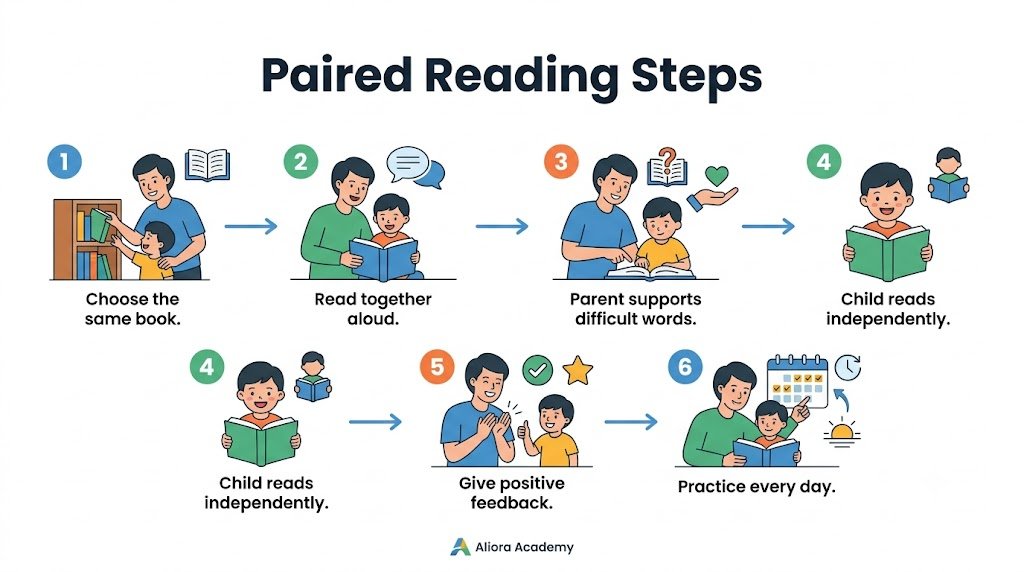
Paired reading is a supported reading technique in which a parent and child read aloud together simultaneously. The adult provides a fluent model while the child joins in as they are able. When the child feels confident enough to read independently, they signal the parent to stop reading aloud, and the child continues solo. If the child encounters difficulty, the parent smoothly rejoins the reading until the child regains confidence.
This approach originated in educational psychology as a method for supporting struggling readers, but it benefits children at all skill levels. The core principle is simple: the child never reads alone until they feel ready, and help is always immediately available.
Why paired reading is so effective:
- It eliminates reading anxiety. The child knows support is right beside them, which reduces the fear of making mistakes.
- It models fluent reading. Hearing a parent read with proper pacing, expression, and accuracy helps children internalize what good reading sounds like.
- It builds stamina gradually. Short, successful sessions encourage longer reading times over weeks and months.
- It strengthens the parent-child bond. Reading together becomes a shared, positive experience rather than a battleground.
- It works across reading levels. Whether your child is just beginning to decode or working on comprehension, paired reading adapts to their needs.
Tracking the text together with a finger helps children follow along and stay engaged during paired reading sessions.
What Are the Key Paired Reading Strategies for Parents to Try at Home?
Paired reading is not a single technique but a family of related approaches. Different strategies work for different children, and you may find that your child responds best to a combination. Here are the most effective paired reading strategies for parents to use during home reading sessions.
Echo Reading
In echo reading, the parent reads a sentence or short passage aloud with clear expression, and the child immediately repeats — or "echoes" — the same words. This strategy is particularly helpful for children who struggle with fluency and prosody, the natural rhythm and intonation of spoken language. By hearing the model first, the child knows exactly what the text should sound like before attempting it themselves.
Echo reading works best with short passages of one to three sentences. As the child becomes more fluent, you can gradually increase the length of the echoed text. This technique pairs well with guided reading activities for grade 3 and similar structured literacy approaches.
Choral Reading
Choral reading involves the parent and child reading the same text aloud simultaneously, in unison, like a small choir. The parent's voice leads slightly, setting the pace and modeling correct pronunciation. The child's voice joins in, matching the rhythm as closely as possible. This technique is excellent for building automatic word recognition because the child hears and says the words at the same time.
Choral reading works well with rhyming books, poetry, and repetitive texts where patterns emerge naturally. It is also a wonderful strategy for children who feel self-conscious about reading alone because their voice blends with the parent's rather than standing out. For children who benefit from auditory reinforcement, pairing print books with audiobooks can extend this practice beyond parent-led sessions.
Alternating Pages or Paragraphs
This strategy is straightforward: the parent reads one page or paragraph aloud, and the child reads the next. The alternating structure gives the child built-in breaks while still keeping them actively engaged. During the parent's turn, the child follows along visually, absorbing vocabulary, sentence structure, and fluency cues. During their own turn, they apply what they have absorbed.
Alternating pages works particularly well for children who have the decoding skills to read but lack the stamina for longer texts. It allows them to tackle books that interest them without becoming fatigued. This approach also supports independent reading activities for elementary kids by gradually extending the amount of text the child reads on their own.
The Pause-Prompt-Praise Method
Developed as part of the original paired reading research, the Pause-Prompt-Praise method gives parents a clear, simple framework for responding to reading errors without discouraging the child. When the child makes a mistake or hesitates, the parent pauses for a few seconds to allow self-correction. If the child does not self-correct, the parent prompts gently — perhaps by drawing attention to the first letter or a familiar word pattern. When the child reads correctly, the parent offers specific, genuine praise.
The Pause-Prompt-Praise Framework at a Glance
- Pause — Wait four to five seconds after a mistake. Give your child a chance to figure it out independently.
- Prompt — If they remain stuck, offer a gentle clue. Say, "Look at the first letter" or "What sound does that letter make?" Avoid simply giving the word away.
- Praise — When they read the word correctly, acknowledge it specifically: "Great job sounding that out!" or "You remembered that word from before — excellent!"
This method teaches children that mistakes are part of learning and that they have strategies for solving reading challenges on their own. Over time, the pauses become shorter and the prompts become less frequent as the child internalizes the problem-solving process.

Specific, genuine praise during paired reading reinforces effort and builds a child's reading confidence over time.
How Do the Different Paired Reading Strategies Compare?
Each strategy serves a slightly different purpose. Understanding these distinctions helps you choose the right approach for your child's current needs.
| Strategy | Best For | Primary Skill Built | Ideal Material |
|---|---|---|---|
| Echo Reading | Children who read in a monotone or struggle with expression | Fluency and prosody | Short, expressive passages; dialogue-heavy texts |
| Choral Reading | Anxious readers who dislike reading alone | Word recognition and pacing | Rhyming books, poetry, songs, predictable texts |
| Alternating Pages | Children with decoding skills but low stamina | Reading endurance and engagement | Chapter books, informational texts, magazines |
| Pause-Prompt-Praise | Children who make frequent errors or give up easily | Self-correction and resilience | Instructional-level texts with occasional challenge words |
Most families find that a blend of these strategies works best. You might start a session with choral reading to warm up, use echo reading for a particularly challenging passage, and apply Pause-Prompt-Praise as your child gains confidence during the session. Browse our reading resources collection to find materials that support each of these approaches.
What Age Groups Benefit Most from Paired Reading?
One of the most common questions parents ask is whether paired reading is only for young children. The answer is a clear no — paired reading strategies benefit children across a wide age range, though the implementation changes as children grow.
Early readers (ages 4–6): At this stage, paired reading focuses heavily on building phonemic awareness and letter-sound correspondence. Choral reading of simple, repetitive texts helps children connect spoken words to printed text. The emphasis is on enjoyment, rhythm, and building a positive association with books.
Developing readers (ages 7–9): This is often the sweet spot for paired reading. Children are building decoding skills and moving toward fluency. Echo reading and the Pause-Prompt-Praise method are particularly effective here. For additional support, explore reading comprehension workbooks for grade 3 that reinforce skills practiced during paired sessions.
Older elementary readers (ages 10–12): Paired reading does not stop being useful after third grade. Older children benefit from alternating pages with more complex chapter books, discussing vocabulary and themes as they go. For children who are significantly behind, books for struggling 4th grade readers provide high-interest content at accessible reading levels, making paired reading feel age-appropriate rather than remedial.
How Do You Choose the Right Books for Paired Reading Sessions?
The success of paired reading depends heavily on selecting appropriate materials. A book that is too difficult causes frustration; a book that is too easy fails to build new skills. The goal is to find texts at your child's instructional level — challenging enough to require some support but not so difficult that the experience becomes discouraging.
Guidelines for selecting paired reading books:
- Use the five-finger rule. Have your child read one page aloud. If they struggle with more than five words, the book is likely too difficult for paired reading. If they struggle with zero or one word, the book may be better suited for independent practice.
- Prioritize high-interest content. A child who loves dinosaurs will persist longer with a challenging dinosaur book than with an easier book on a topic they find boring. Interest fuels effort.
- Look for rich language and rhythm. Books with natural cadence, rhyme, and repetition make choral and echo reading more enjoyable and effective.
- Include a mix of fiction and nonfiction. Informational texts build vocabulary and background knowledge, while stories develop narrative comprehension. Both matter.
- Choose books with clear print and manageable text density. Cluttered pages overwhelm struggling readers. Look for clean layouts with adequate white space.
For children who need systematic support with decoding, a structured phonics program for struggling readers can complement paired reading by addressing gaps in foundational skills. The combination of direct phonics instruction and supportive paired practice is powerful.
What Common Mistakes Should Parents Avoid During Paired Reading?
Even with the best intentions, parents sometimes fall into patterns that undermine the effectiveness of paired reading. Being aware of these common missteps helps you create a more productive and positive experience for your child.
Real-Life Examples of Paired Reading in Action
Example 1: Building Confidence in a Reluctant First Grader
Situation: Amir, age 6, avoids reading at home and says he is "bad at reading." His teacher reports that he has adequate phonics knowledge but freezes when asked to read aloud in class.
Challenge: Amir's reading anxiety is preventing him from demonstrating the skills he actually possesses. He needs to rebuild his confidence in a low-pressure environment.
Solution: His mother started with choral reading using highly predictable, repetitive books that Amir could join in on easily. She chose texts with rhymes and patterns so Amir could anticipate the words. For the first two weeks, she did not ask him to read a single word alone — they read everything together, in unison. Gradually, she introduced alternating pages, letting Amir choose which pages he wanted to read solo.
Learning Outcome: After a month, Amir began volunteering to read aloud at home without prompting. His teacher noticed increased participation during small-group reading. The key was removing the performance pressure entirely during the initial phase.
Takeaway: For anxious readers, start with complete support and fade it gradually. Never rush the process of building trust in the reading environment.
Example 2: Improving Fluency in a Third Grader Who Reads Word by Word
Situation: Lena, age 8, decodes words accurately but reads in a choppy, word-by-word manner with no expression. Her comprehension suffers because all her mental energy goes into reading individual words.
Challenge: Lena needs to develop reading fluency — the ability to read smoothly, at a conversational pace, with appropriate phrasing and expression.
Solution: Her father used echo reading as the primary strategy. He would read one sentence with natural expression and phrasing, and Lena would echo it back immediately. He chose texts with dialogue and emotion so there was a clear "right way" to read with expression. They focused on the same short passage for several sessions, allowing Lena to master the phrasing before moving on.
Learning Outcome: Within six weeks, Lena's oral reading showed noticeable improvement in pacing and expression. She began to self-correct her phrasing even when reading unfamiliar texts. For additional fluency practice, her parents explored reading intervention activities that reinforced the skills built during paired sessions.
Takeaway: Fluency develops through repeated exposure to fluent models. Echo reading provides an immediate, clear model that children can replicate.
Example 3: Supporting an Older Struggling Reader Without Embarrassment
Situation: Marcus, age 11, reads several grade levels behind his peers. He is acutely aware of the gap and resists any activity that feels "babyish." His parents want to help but worry about making him feel singled out.
Challenge: Finding paired reading materials and approaches that feel age-appropriate for a fifth grader while still being accessible at his reading level.
Solution: Marcus's parents used alternating pages with high-interest nonfiction books about space exploration and graphic novels — formats that feel mature but include visual supports. They framed the sessions as a shared activity: "Let's read this together because it's interesting," not "Let's work on your reading." They also integrated audiobooks paired with print books so Marcus could follow along independently when his parents were not available.
Learning Outcome: Marcus began to engage with books voluntarily for the first time in years. The alternating-page structure meant he never had to sustain reading long enough to become exhausted, and the mature content preserved his dignity. Over several months, his stamina and confidence grew steadily.
Takeaway: For older struggling readers, the right materials and a respectful, collaborative tone make all the difference. Paired reading should never feel like a punishment or a remedial exercise.
How Can Paired Reading Fit Into a Busy Family Schedule?
One of the most practical concerns parents raise is finding time for yet another activity in an already packed day. The good news is that paired reading does not require long sessions to be effective. In fact, short, consistent practice yields better results than occasional marathon sessions.
Practical ways to integrate paired reading:
- Morning connection time. Ten minutes of paired reading over breakfast or before school starts the day with calm connection.
- After-dinner routine. Replace a few minutes of screen time with a short paired reading session. It becomes a predictable, comforting ritual.
- Bedtime wind-down. Paired reading fits naturally into the bedtime routine and helps children settle down while building skills.
- Weekend mornings. A slightly longer session on Saturday or Sunday, when there is less time pressure, can be a relaxed and enjoyable tradition.
- Alternate parents. If both parents are available, taking turns with paired reading duties prevents burnout and gives the child exposure to two fluent reading models.
The key is consistency over duration. Ten minutes a day, five days a week, adds up to over forty hours of supported reading practice in a year — a significant investment in your child's literacy. For days when parent-led reading is not possible, independent reading activities can help bridge the gap.
When Should You Consider Additional Reading Support Beyond Paired Reading?
Paired reading is a powerful tool, but it is not a standalone solution for every reading challenge. Knowing when to seek additional support ensures your child receives the right kind of help at the right time.
Consider additional support if:
- Your child shows little progress after several months of consistent paired reading practice.
- Your child has significant difficulty with decoding despite knowing letter sounds — this may indicate a need for structured phonics intervention.
- Your child's reading level remains well below grade-level expectations despite regular support.
- Your child displays signs of a possible learning difference, such as persistent letter reversals beyond the early elementary years or extreme difficulty with phonological awareness.
- A teacher or reading specialist has recommended targeted intervention.
Structured reading intervention programs and reading intervention resources for elementary students can complement the work you do at home. These programs provide systematic, sequential instruction that targets specific skill gaps. Paired reading then becomes the practice ground where newly learned skills are applied in a supportive context.
Frequently Asked Questions About Paired Reading Strategies for Parents
How long should a paired reading session last?
For most elementary-aged children, ten to fifteen minutes per session is ideal. Younger children or those with attention challenges may do better with five to eight minutes. The goal is to end the session while your child still feels engaged and successful, not exhausted. Consistency — four to five sessions per week — matters far more than the length of any single session.
What if my child refuses to read aloud with me?
Resistance often stems from anxiety or past negative experiences. Start by reading aloud to your child with no expectation of participation for several sessions. Let them follow along visually. Gradually invite them to join in on repetitive phrases or sound effects. The transition to full paired reading should feel natural and unforced. If resistance persists, consider whether the material is at the right level or if your child may benefit from additional support to address underlying reading difficulties.
Can paired reading work with more than one child at a time?
Paired reading is most effective one-on-one because each child has unique needs that require individualized pacing and support. However, choral reading can work with siblings if they are at similar reading levels. For families with multiple children, consider short individual sessions with each child rather than trying to combine them. Some parents alternate evenings or have one parent read with one child while the other parent reads with another.
Do I need special training to use paired reading strategies?
No special training is required. The techniques described in this guide are designed to be accessible to any parent. The most important qualifications are patience, consistency, and a willingness to follow your child's lead. If you want additional guidance, many schools and libraries offer parent workshops on reading support strategies, and our blog provides ongoing tips and resources.
How is paired reading different from just reading aloud to my child?
Reading aloud to your child is valuable and should continue throughout the elementary years, but it is a passive experience for the child — they listen but do not actively practice reading. Paired reading is interactive; the child actively reads alongside you, building their own skills in real time with your support as a scaffold. Both activities belong in a well-rounded literacy routine, but they serve different purposes.
What if my child and I both find paired reading frustrating?
Frustration usually signals a mismatch — the material may be too difficult, the session may be too long, or the strategy may not be the right fit for your child's needs. Take a step back. Switch to a different strategy, choose an easier book, or shorten the session. If frustration continues, it may be worth exploring reading comprehension workbooks or other resources that allow your child to build skills independently before returning to paired practice. Sometimes a brief break from the technique helps both parent and child reset.
Can paired reading help with reading comprehension, or is it only for fluency?
Paired reading supports comprehension in several ways. When the parent models fluent reading, the child's mental energy is freed from decoding and can focus on meaning. Additionally, the parent can pause briefly to ask a natural, conversational question — "Why do you think the character did that?" — before resuming. These brief check-ins deepen understanding without turning reading into a quiz. Over time, children internalize the habit of thinking about what they read.
Should I use paired reading with a child who is already a strong reader?
Yes. Strong readers also benefit from paired reading, though the focus shifts. With fluent readers, paired reading can be used to tackle more complex texts, explore rich vocabulary, and engage in deeper discussions about themes and ideas. Alternating pages with challenging material exposes strong readers to text they might not yet have the stamina to read independently, accelerating their growth. The shared experience also strengthens the parent-child connection around reading.
Making Paired Reading a Lasting Part of Your Family's Reading Life
Paired reading is not a quick fix or a one-time intervention. It is a practice — a way of being with your child around books that builds skills, confidence, and connection over time. The strategies outlined in this guide — echo reading, choral reading, alternating pages, and the Pause-Prompt-Praise method — give you a flexible toolkit that adapts as your child grows.
The most important ingredient in any paired reading session is not the technique itself but the quality of attention and encouragement you bring to it. When your child associates reading with warmth, support, and shared enjoyment, they develop not only the skills to read well but the desire to keep reading — and that desire is what carries them forward as lifelong learners.
Start small. Choose one strategy that feels natural. Pick a book your child is genuinely interested in. Set aside ten minutes. Let the session be imperfect. Over days and weeks, the routine will take hold, and you will begin to notice the small shifts — a word sounded out independently, a sentence read with expression, a page turned with confidence. These are the building blocks of reading success.
For materials that support your paired reading practice, explore our reading resources collection, where you will find books, workbooks, and tools organized by skill level and interest. Visit our homepage to discover our full range of educational resources for families and educators. If you have questions about selecting the right materials for your child, we welcome you to contact us — we are here to help.
Every child can become a stronger, more confident reader. With consistent paired reading and the right resources, you can help your child discover that reading is not something to be feared or avoided — it is a door to new worlds, and you get to walk through it together.